

Environment Controllers Buying Guide 2026: Optimise Your Grow Room Climate
Did you know that integrating IoT-enabled management systems into your setup can reduce energy consumption by as much as 30%? Most growers spend far too many hours manually tweaking fan speeds or stressing over humidity spikes that lead to mould. It's frustrating to watch your plants suffer from inconsistent conditions when you aren't there to make a change. High-quality environment controllers eliminate this guesswork by taking over the heavy lifting of climate management. You want consistent results without the extra work.
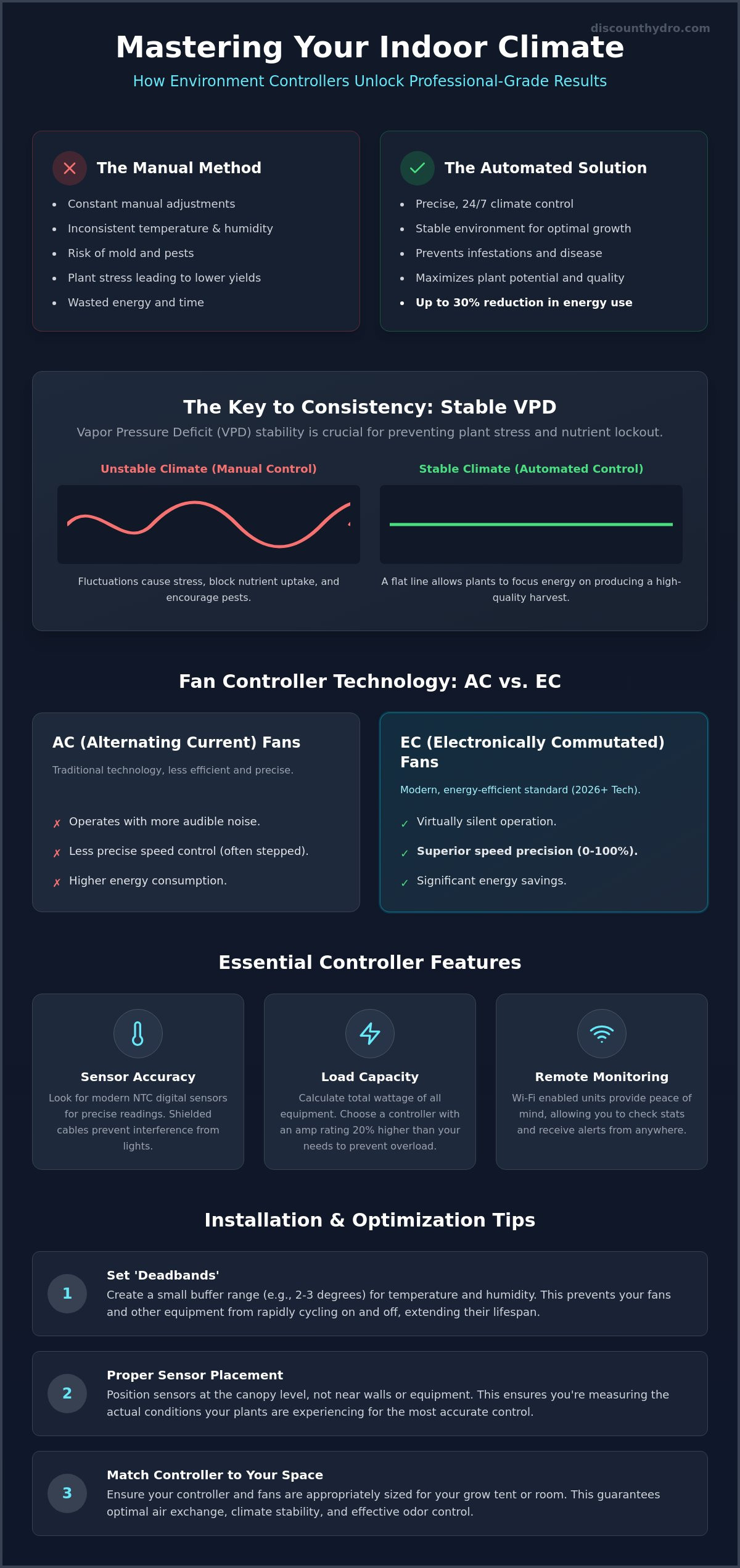
We agree that manual climate management is a relic of the past. Our expert guide helps you discover how to automate your indoor garden for maximum yields by selecting the perfect controller for your specific needs. You'll gain total control over your grow room climate and achieve the stable VPD levels necessary for professional results. We'll cover the latest 2026 technology, including the impact of new federal refrigerant regulations and the shift toward energy-efficient EC fans. This breakdown provides everything you need to choose a system that offers remote monitoring and total peace of mind.
Key Takeaways
- Understand how stable VPD levels prevent plant stress and nutrient lockout through automated climate management.
- Identify the critical differences between AC and EC fan controllers for silent operation and superior speed precision.
- Select the right environment controllers by calculating load capacity and evaluating NTC sensor accuracy for your setup.
- Learn to set 'Deadbands' during installation to prevent equipment from rapidly cycling and extend the life of your fans.
- Match your controller tier to your specific grow tent size to ensure optimal air exchange and climate stability.
Why Environment Controllers Are Essential for Professional Results
Professional growers view environment controllers as the command centre of the grow room. It's a central hub that automates the monitoring and adjustment of temperature, humidity, and CO2. This technology is the fundamental core of Controlled-environment agriculture (CEA). Without this automation, you're constantly reacting to environmental swings rather than maintaining a steady state. Using a controller means you aren't guessing about fan speeds or humidity levels; you're setting precise parameters for success.
Consistency determines the quality of your harvest. Fluctuating Vapor Pressure Deficit (VPD) levels cause significant plant stress. This often leads to nutrient lockout because the plant's metabolic rate can't keep up with the shifting environment. When your climate stays stable, plants dedicate their energy to flower production rather than trying to survive a heatwave or a cold snap. Maintaining a flat line on your data charts is the fastest way to hit professional-grade results.
Stable climates also act as your first line of defence against infestations. Pests like spider mites love hot, dry pockets of air that occur when circulation is poor. High-quality environment controllers ensure these pockets never form by keeping air moving based on real-time sensor data. They offer a massive ROI because they protect your investment. They're just as vital for your bottom line as using premium hydroponic nutrients.
Eliminating Human Error in Climate Management
Manual fan adjustments are inefficient and risky. If you forget to turn up the fans during a midday heatwave or fail to adjust them during the night cycle, your crop pays the price. Automated sensors react faster than any grower. They maintain the precise balance between intake and extraction fans to keep negative pressure in your tent. This prevents odours from leaking and ensures a constant supply of fresh air even when you're asleep.
The Link Between Stable Environments and Yield
Temperature spikes during the 'lights on' period stunt growth and burn off essential oils. High humidity is equally dangerous. It blocks transpiration, which stops the plant from pulling up water and minerals from the roots. Controllers manage the heat output from LED grow lights by adjusting fan speeds in real-time to keep your canopy in the sweet spot. This precision directly translates to heavier, denser fruits and better overall vigour.
Key Features to Compare When Choosing a Controller
Selecting the right environment controllers requires a focus on technical specifications over aesthetic design. Accuracy starts with the sensor type. Modern digital NTC (Negative Temperature Coefficient) sensors provide far superior precision compared to older analogue probes. These sensors react to minute changes in the atmosphere, allowing the controller to make micro-adjustments to fan speeds. Research from Cornell's CEA program highlights how precise environmental monitoring is essential for optimizing plant physiology in indoor settings. If your sensor is off by even two degrees, your VPD calculations will be incorrect, potentially leading to stunted growth.
Load capacity is another critical factor. You must calculate the total wattage of every device the controller will manage. This includes your extraction fans, intake fans, and any heaters or dehumidifiers. Overloading a controller can blow internal fuses or cause a fire hazard. Always look for a unit with an amp rating that exceeds your combined equipment draw by at least 20%. This buffer ensures the hardware runs cool and lasts longer under constant use.
Sensor Accuracy and Reliability
Reliability depends on the quality of the connection. High-end environment controllers use shielded cables to prevent electromagnetic interference from your ballasts or LED drivers. Without shielding, your readings might flicker or show false spikes. Position your sensors at the canopy level for the most accurate average reading of what the plants actually experience. For larger rooms, dual-zone sensing is a game-changer. It allows you to monitor different areas of the space simultaneously to identify stagnant air pockets or heat zones that single sensors miss.
Connectivity and Remote Monitoring
Remote access provides essential security for your investment. Wi-Fi enabled units allow you to check your stats from any location, while Bluetooth is a solid choice for smaller setups where you're always in close proximity. Push notifications for high-temperature or low-humidity alerts enable you to react before damage occurs. Data logging is equally valuable. Using historical charts helps you spot environmental trends, such as humidity spikes during the night cycle that you'd otherwise miss. If you're ready to upgrade your setup, explore our range of pro-grade climate gear to find the right fit for your room.
Expandability ensures your hardware doesn't become obsolete as your hobby grows. Modular systems allow you to add more sensors or control modules as you scale your operation. Decide between an intuitive touchscreen interface for quick adjustments or physical dials for rugged durability in humid environments. Your choice should reflect your current scale and your plans for future expansion. All-in-one units are great for tents, but modular systems offer the flexibility needed for dedicated grow rooms.
Technical Breakdown: AC vs. EC Fan Speed Controllers
AC controllers are the traditional choice for managing standard ventilation. They work by reducing the voltage sent to the fan motor to slow it down. While these units are cost-effective and reliable, they have a known technical drawback. Reducing voltage often creates a loud electrical "hum" or "buzz" when the fan runs at low speeds. This noise is a result of the motor struggling with the modified power supply. It also puts additional stress on the fan motor, which can lead to a shorter lifespan for your extraction equipment.
EC controllers represent the modern standard for precision climate management. These environment controllers use digital signals to communicate with Electronically Commutated (EC) motors. The result is total silence, even when the fan is running at 1% power. You get much smoother speed transitions. This prevents the sudden pressure drops that can disrupt your VPD levels. Because the control is digital, it's far more accurate than the analogue voltage reduction used in older systems.
Energy efficiency is the strongest argument for choosing EC technology. While the initial hardware cost is higher, EC fans and controllers often pay for themselves through reduced electricity bills. Unlike AC fans, which draw nearly full power even at low speeds, EC motors only consume the energy required for their current RPM. Some advanced environment controllers now offer a "hybrid" middle ground. These units feature both AC outlets for traditional heaters and digital ports for EC fans. This allows you to manage a mixed equipment setup from a single, centralized device without needing multiple adapters; it's a great option for those who infrarood panelen kopen and want professional control over their heating hardware.
Simple Fan Speed Controllers for Beginners
Plug-and-play units are the best entry point for small setups. These controllers usually feature a single temperature probe and a dial to set your target heat. They're excellent for managing negative pressure. This ensures your extraction fan pulls enough air to keep your carbon filter effective at all times. It's the simplest way to prevent odours from escaping the room. However, basic units often struggle in high-humidity environments. They lack the specialized sensors needed to calculate VPD or trigger dehumidifiers automatically.
Integrated Master Controllers for Full Automation
For larger operations, integrated master controllers provide a total room solution. These devices sync your lighting cycles, fans, and CO2 injection from one interface. A key feature is the ability to automatically dim your LED grow lights if the room temperature exceeds a safe limit. This prevents crop damage during equipment failures or heatwaves. By synchronising multiple fans, these controllers maintain perfect air exchange without the need for constant manual intervention. It's the most efficient way to scale your garden while maintaining professional standards.
Top-Rated Environment Controllers for 2026
Choosing between different environment controllers depends entirely on the scale of your operation. A hobbyist setup doesn't require the same level of complexity as a multi-room facility. You must match the controller to your grow tent size to ensure efficient air exchange. High-end models for 2026 now focus heavily on IoT integration, allowing for predictive maintenance and real-time alerts. Selecting a tier that fits your current needs prevents overspending on features you won't use while ensuring your plants stay within safe parameters.
Global Air Supplies (G.A.S) remains the leading name for precision climate gear in the UK. Their hardware is built for durability in high-humidity environments and offers seamless integration with EC fan technology. For those seeking a fully "smart" grow room, TrolMaster is the industry standard. Their modular systems allow you to connect everything from lighting to irrigation under one brain. This modularity is a key trend for 2026, as it lets you start with a basic setup and add sensors as you scale. Both brands prioritize reliability, which is essential for maintaining peace of mind when you're away from the garden.
Best for Small Tents and Hobbyists
If you're running a single-fan setup in a 1.2m x 1.2m space, a simple thermostat-based unit like the RAM AIR-PRO II is often sufficient. These plug-and-play controllers are easy to set up and focus on the essentials. They manage extraction based on temperature triggers to keep your environment stable. You don't need complex data logging for a small hobby tent. Reliability and ease of use are the primary goals here. These units are cost-effective and provide a significant upgrade over manual fan speed dials, ensuring your plants don't overheat during the day cycle.
Professional-Grade Infrastructure Solutions
Larger operations require the G.A.S Enviro Controller V2. This unit manages multiple fans and features programmable AC outlets for heaters or humidifiers. It's designed for growers who need to synchronise intake and extraction perfectly to maintain negative pressure. For facility-wide control, the TrolMaster Hydro-X is the ultimate choice. It manages up to 512 lights and multiple environmental zones simultaneously. You can also use customisable relay boxes to handle heavy-duty equipment like industrial dehumidifiers. If you're looking to professionalise your setup, you can buy environment controllers online at competitive prices to secure your harvest.
Budget-friendly options still offer reliable performance for cost-conscious growers. While they may lack the advanced Wi-Fi features of premium models, they provide accurate temperature and humidity monitoring. Always ensure your chosen unit has the load capacity to handle your specific fans. Investing in a dedicated controller is the most effective way to transform a basic garden into a professional-grade production space.
How to Install and Optimise Your Controller
Installing environment controllers correctly is the only way to ensure your grow room operates at peak efficiency. Start by positioning your sensor at canopy height, away from direct light or misting systems. Secure the main unit to a wall outside the grow space to protect it from high humidity. Plug your extraction and intake fans into the designated ports, then connect any heaters or dehumidifiers. You must never exceed the rated amp limit of your controller to avoid electrical failure or fire hazards.
Once connected, you need to set your 'Deadbands'. A deadband is a small range above or below your setpoint where the controller remains inactive. For example, if your target is 25°C and your deadband is 2°C, the cooling won't kick in until the room hits 27°C. This prevents your equipment from rapidly cycling on and off every few seconds. Frequent cycling wears out fan motors and relay switches prematurely. Setting proper deadbands extends the life of your hardware and creates a more stable environment for your plants.
Regular maintenance ensures long-term accuracy. Dust and nutrient residue can build up on sensor probes over time, leading to false readings. Wipe your sensors with a soft, dry cloth every two weeks. Avoid using harsh chemicals that might damage the sensitive NTC components. If your controller allows for calibration, check it against a trusted handheld thermometer once a month to verify precision. Reliable data is the only way to maintain a professional garden.
Matching Controller Capacity to Your Equipment
Understanding electrical loads is vital for safety. Resistive loads, like standard heaters, draw power consistently. Inductive loads, such as fan motors, require a massive surge of energy to start up. This 'inrush current' can be several times higher than the fan's running wattage. If you're running high-wattage equipment or multiple lights, you should use a contactor relay. This device takes the heavy electrical load off the controller's internal circuitry. Always verify that your plugs and fuses meet UK safety standards before powering up your system.
Optimising Settings for Maximum Efficiency
Your temperature setpoints should change based on the plant's life cycle. During the 'lights on' period, aim for 24 to 26°C. When the lights go off, drop the target to 18 to 20°C to mimic natural conditions. Use the 'Minimum Fan Speed' setting to keep air moving even when the room is cool. This maintains negative pressure and keeps your carbon filters working to scrub odours. It also prevents stagnant air, which is a major cause of mould and pest issues. Ready to upgrade? Browse our full range of environment controllers and start automating today.
Upgrade Your Grow Room Automation Today
Efficient climate management is the difference between a standard harvest and a professional-grade yield. Environment controllers provide the precision needed to maintain stable VPD levels and prevent environmental stress. By integrating EC fan technology and automating your lighting cycles, you reduce energy waste and eliminate the risks associated with manual adjustments. It's time to move beyond guesswork and secure your setup with hardware that reacts faster than any grower can.
We currently have 31 professional-grade controllers in stock to suit every tent size and budget. Our team provides expert technical support to ensure you select the right load capacity for your fans and heaters. You can also rely on fast UK-wide delivery to get your equipment running as soon as possible. Professional results require professional tools. Shop the Full Collection of Environment Controllers and take the first step toward a fully automated grow room. Start optimising your climate now to ensure your plants reach their full potential.
Frequently Asked Questions
Do I really need an environment controller for a small grow tent?
Yes, automation is essential even in small tents because environmental swings happen rapidly in confined spaces. Without environment controllers, heat from lights or humidity spikes can stunt growth in hours. A basic unit ensures your extraction fan reacts to temperature changes automatically. This provides peace of mind and more consistent harvest quality compared to manual fan speed adjustments that require constant human presence.
What is the difference between a fan speed controller and a climate controller?
Fan speed controllers only allow you to manually set a fixed motor speed. Climate controllers use sensors to adjust equipment based on real-time data. A climate controller monitors temperature and humidity to speed up or slow down fans as needed to hit your specific targets. This automation maintains a steady environment while a simple speed dial requires constant intervention to react to external weather changes.
Can one controller manage both my lights and my extraction fans?
Integrated master controllers can manage both lighting cycles and extraction fans from a single interface. These advanced units often feature a dimming function that lowers light intensity if the room temperature exceeds a safe threshold. This dual management prevents crop damage during heatwaves or equipment failures. You should verify that your specific LED grow lights are compatible with the controller's dimming protocol before purchase.
Will an environment controller help with humidity and mould issues?
Environment controllers are your best defence against mould because they maintain air exchange based on humidity levels. High humidity during the night cycle is a primary cause of botrytis and powdery mildew. A controller can trigger higher fan speeds or activate a dehumidifier when moisture levels rise. This keeps air moving and prevents the stagnant, damp conditions that pathogens need to thrive in your garden.
What is VPD and should I look for a controller that measures it?
VPD stands for Vapor Pressure Deficit and measures the relationship between temperature and humidity. It's a more accurate metric for plant transpiration than relative humidity alone. Choosing a controller that calculates VPD allows for much tighter climate management. This ensures your plants can efficiently pull up nutrients and water. Most professional-grade units for 2026 now include VPD monitoring as a standard feature for precision growing.
Are EC fan controllers better than AC fan controllers?
EC fan controllers are superior because they offer silent operation and greater energy efficiency. Unlike AC controllers that reduce voltage and cause motors to hum, EC units use digital signals for smooth speed transitions from 1% to 100%. This precision allows for better climate stability. While the initial hardware cost is higher, the electricity savings and reduced noise make them the preferred choice for modern indoor setups.
How do I know if my fans are compatible with a specific controller?
Compatibility depends on the fan motor type and the total amp draw. You must match an AC fan with an AC controller and an EC fan with a digital EC controller. Always check the maximum load rating of the controller against the combined wattage of your fans. Exceeding this limit will blow fuses or damage the internal circuitry. Most manufacturers list compatible fan brands in their technical specifications for easy verification.
Can I monitor my grow room environment from my phone?
Many modern controllers feature Wi-Fi or Bluetooth connectivity for remote monitoring via smartphone apps. This allows you to check temperature, humidity, and VPD levels from any location. You can also receive push notifications if parameters fall outside your safe range. This feature is standard on premium models and various modular systems. It's an essential tool for maintaining total control over your environment without being physically present.