

How to Grow Bigger Yields Indoors: The 2026 Professional Guide
Industry data shows that CO2 enrichment can increase harvest weight by up to 43% in optimized, sealed environments. Many growers face stagnant yields and high energy costs that only produce fluffy or airy development. Learning how to grow bigger yields indoors is a matter of technical precision rather than luck. It's about technical execution. You need a strict balance of photonic pressure, nutrient bioavailability, and atmospheric control to ensure every square inch of your grow room is productive.
You've likely dealt with the frustration of nutrient burn while trying to compensate for slow growth. We're here to help you master the technical variables of lighting, nutrition, and environment to maximize your harvest weight and quality. This 2026 professional guide previews the latest LED standards, CO2 PPM targets, and automated systems required for denser harvests and faster growth cycles. These protocols are designed for growers who prioritize efficiency and measurable results.
Key Takeaways
- Optimize light intensity by focusing on PAR and PPFD metrics to drive maximum harvest weight.
- Discover how to grow bigger yields indoors by using training techniques that eliminate apical dominance and create a flat, efficient canopy.
- Prevent nutrient lockout and stunted growth by balancing N-P-K ratios with precise atmospheric VPD control.
- Increase biomass by up to 43% through strategic CO2 enrichment and advanced environmental management.
- Improve root zone oxygenation and plant health by selecting the right growing media and pot systems.
Maximising Light Intensity: The Engine of Indoor Yields
Light is the primary driver of photosynthesis. In Controlled-environment agriculture, your lighting system acts as the engine for crop production. To understand how to grow bigger yields indoors, you must move past wattage and focus on Photosynthetically Active Radiation (PAR). PAR measures the specific wavelengths of light between 400 and 700 nanometers that plants use for growth. This is the only metric that directly correlates with your final harvest weight. High wattage doesn't guarantee results if the light isn't within the PAR spectrum.
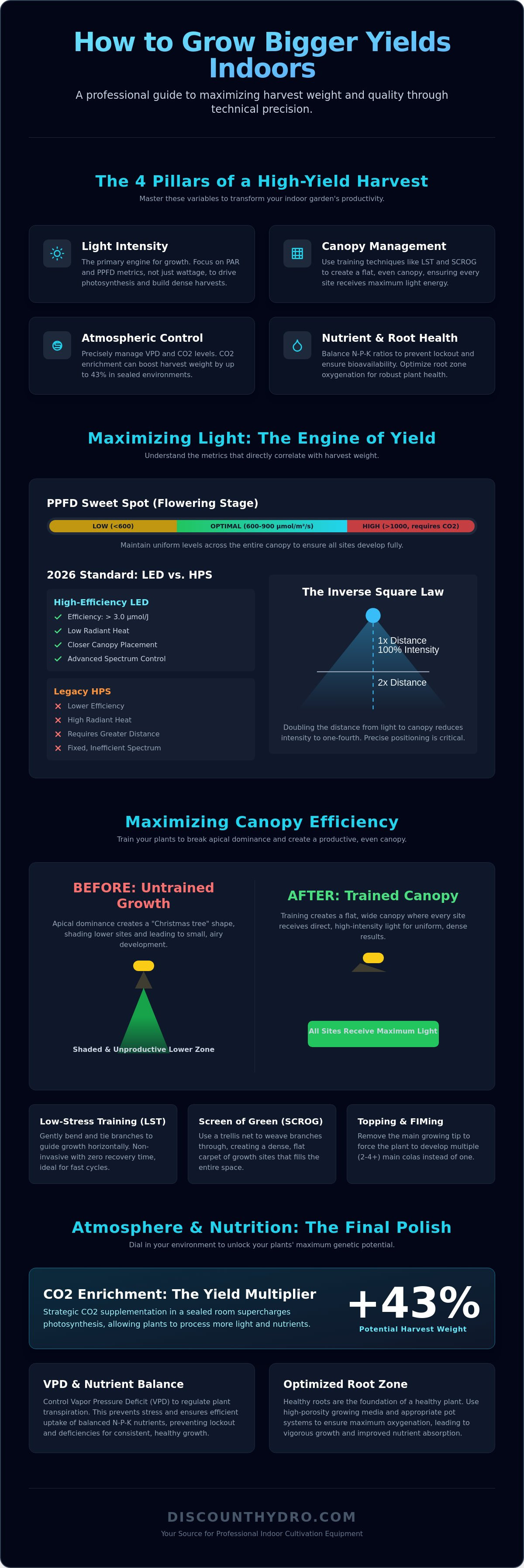
Photosynthetic Photon Flux Density (PPFD) measures how much of that PAR actually hits your plant canopy every second. Managing this value requires an understanding of the Inverse Square Law. This law states that light intensity decreases exponentially as the distance between the light source and the canopy increases. Doubling the distance reduces the intensity to one-fourth. This makes canopy management and light positioning critical for maximizing penetration and preventing airy development at the bottom of the plant. Proper positioning ensures that energy isn't wasted on the walls of your grow room.
Understanding PPFD and Light Maps
Modern growers use light maps to identify "dead zones" where intensity drops off at the edges of the grow tent. For the flowering stage, the 600-900 µmol/m²/s range is the sweet spot for most fruiting crops. If your PPFD falls below 600, you'll see reduced density. If it exceeds 1,000 without CO2 supplementation, you risk light stress and bleaching. Uniform distribution ensures that every fruiting site, not just the top cola, receives enough energy to develop fully. Using PAR meters to verify these levels across the entire canopy is a standard practice for anyone looking at how to grow bigger yields indoors.
The 2026 Shift: Why LED Trumps HPS for Harvest Weight
Upgrading to high-efficiency LED grow lights is the fastest way to increase your yield per watt. In 2026, top-tier professional LEDs exceed 3.0 µmol/J efficiency. Unlike HPS lamps, LEDs produce significantly less radiant heat. You can position them closer to the canopy without burning the plants. This proximity increases light penetration and fruit density. Modern LED models also incorporate multi-channel spectrum control, allowing you to adjust UV and Far Red light to influence specific plant development stages. You get more micromoles of light for every pound spent on electricity, reducing your overhead while boosting your output.
Plant Training Techniques to Maximise Canopy Efficiency
Plants naturally prioritize the main stem through apical dominance. This creates a "Christmas tree" shape. While efficient in nature, this structure is a major obstacle when learning how to grow bigger yields indoors. The top cola receives the highest light intensity; lower branches suffer in the shade. This leads to uneven development and airy harvests. Breaking this dominance is essential for a professional-grade result. By redistributing growth hormones, you force the plant to develop multiple primary colas.
A flat canopy ensures every fruiting site receives maximum PPFD. This uniform distribution of light energy is what drives biomass. When you train plants to grow horizontally, you maximize your footprint. This strategy is supported by USDA-funded indoor agriculture research. This research highlights the importance of optimizing environmental variables and plant architecture for profitability. Proper structure also improves airflow. In a crowded grow tent, stagnant air pockets lead to mold or pests. Trellising and netting provide the physical support needed to hold heavy harvests without branch breakage.
Low-Stress Training (LST) and Screen of Green (SCROG)
LST is a non-invasive method to manipulate growth. It doesn't involve cutting the plant, so recovery is immediate. This makes it ideal for maintaining fast growth cycles. You start by gently bending the main stem toward the edge of the pot. This exposes lower nodes to direct light. Use soft ties to secure branches and maintain an even height across all growing tips. Once the structure is established, install a SCROG net. Weave branches through the mesh to fill every square inch of your space. This creates a dense carpet of fruit sites that all receive equal light energy.
Topping and FIMing for Multiple Colas
Topping involves removing the tip of the main stem. This forces the plant to produce two primary colas instead of one. FIMing is a variation where you remove about 75% of the tip. This often results in four or more new colas. Both methods are effective strategies for how to grow bigger yields indoors by increasing the number of high-production sites. However, these are high-stress techniques. You must allow plants to bounce back for 5-7 days before switching to the flowering stage. If you don't provide this recovery time, you risk stunted growth and reduced harvest weight. Using high-quality plant nutrients and supplements helps accelerate the healing process and ensures vigorous regrowth after high-stress training sessions.
Nutrient Precision and Bioavailability
Plants require different elemental ratios depending on their life cycle. During the heavy fruiting phase, Phosphorus and Potassium (P and K) become the primary drivers of biomass. High Nitrogen levels at this stage can actually inhibit fruit development and lead to airy results. If you want to know how to grow bigger yields indoors, you must master the shift in N-P-K ratios. Phosphorus fuels energy transfer and root development, while Potassium regulates water movement and enzyme activation. Using dedicated PK boosters during the peak of the flowering cycle is a proven method for increasing fruit density and final harvest weight.
Many growers fall into the "Nutrient Lockout" trap. They assume that adding more fertilizer always leads to more growth. This is false. Excessive mineral salts build up in the growing media; this prevents the roots from absorbing essential elements. This results in deficiencies even though the nutrients are present. For a structured approach to base feeding, refer to our guide to hydroponic nutrients. Maintaining a lean, precise feeding schedule is often more effective than over-compensating with high concentrations.
Monitoring pH and EC for Maximum Uptake
Nutrient solubility depends entirely on the pH of your solution. In hydroponic and coco-based systems, a pH range of 5.8-6.2 is critical. If your levels drift outside this window, certain elements become chemically unavailable to the plant. You also need an Electrical Conductivity (EC) meter to measure the total salt concentration of your feed. This tool tells you exactly how strong your nutrient solution is. Always adjust your feed strength based on plant response. If you see yellowing or brown tips, it's a sign of tip burn. Lower your EC immediately to prevent permanent damage to the foliage.
The Power of Additives and Boosters
Base nutrients provide the foundation, but additives refine the results. Silicon is a vital supplement that strengthens cell walls. This helps your plants support the heavier harvests you're aiming for without snapping under the weight. In high-intensity LED environments, plants often require additional Cal-Mag. The increased metabolic rate under LEDs can deplete Calcium and Magnesium faster than traditional lighting setups. Finally, incorporate enzymes and beneficial bacteria into your reservoir. These biological additives break down dead root material and convert it into usable energy. This keeps the root zone healthy and ensures maximum nutrient absorption throughout the entire cycle. Mastering these variables is a core component of how to grow bigger yields indoors.
Environmental Control: VPD and CO2 Enrichment
Vapour Pressure Deficit (VPD) is the technical variable that defines how your plants interact with their environment. It measures the difference between the moisture in the air and how much moisture that air can hold when saturated. This pressure determines the rate of transpiration. If your VPD is too low, plants can't "sweat," which halts the pull of nutrient-rich water from the roots. If it's too high, plants close their stomata to prevent dehydration, effectively stopping photosynthesis. Mastering this balance is a requirement for anyone learning how to grow bigger yields indoors.
Temperature and humidity work in tandem to regulate these stomatal openings. In 2026, professional growers use integrated environment controllers to automate these adjustments. This precision prevents the stagnant growth cycles caused by environmental stress. You must also protect your investment from external threats. An unoptimized environment invites pests; follow our guide on eliminating spider mites to ensure your harvest isn't compromised before it reaches the scales.
Managing the VPD Sweet Spot
Your target VPD shifts as plants mature. During the vegetative stage, aim for a range of 0.8 to 1.1 kPa to encourage lush foliage development. As you transition to the flowering stage, increase the VPD to 1.2 to 1.5 kPa. This higher pressure drives the heavy nutrient uptake required for dense fruit production. Use high-performance extraction fans and digital controllers to maintain these levels. High humidity in late flower is the primary threat to harvest quality, as it leads to internal rot and mold. Keeping humidity below 45% during the final weeks is non-negotiable for professional-grade results.
CO2: The Ceiling Breaker
Carbon dioxide is the building block of plant tissue. Ambient air contains roughly 400 PPM of CO2, but plants can process much more. Research shows that enrichment up to 1,200 or 1,500 PPM can increase yields by 30-43% in optimized setups. This is a core strategy for how to grow bigger yields indoors. However, CO2 is only effective if your light intensity is high enough to process the extra fuel. Do not supplement CO2 unless your PPFD is above 1,000 µmol/m²/s. Without that "photonic pressure," the extra gas is wasted. For small tents, simple CO2 bags provide a cost-effective boost. Professional rooms require regulated tank systems for precise delivery. Always prioritize safety by using CO2 monitors and ensuring your grow space is properly sealed. To upgrade your climate management, browse our professional environmental control systems.
Optimising Your Setup for Consistent Harvest Success
Your root zone is the foundation of your final weight. Choosing the right pot size is critical; root-bound plants stop producing because the lack of space restricts nutrient transport and oxygen access. This leads to stunted growth and lower fruit density. To understand how to grow bigger yields indoors, you must prioritise root health. Air-Pots and fabric pots are superior to traditional plastic containers. These systems provide air-pruning, which prevents roots from circling and encourages a dense, fibrous root mass. Increased oxygenation in the media leads to faster nutrient uptake and more vigorous development.
Maximise your lighting efficiency by using high-quality reflective wall materials. Mylar or white Orca film ensures that stray photons are bounced back onto the lower and side canopy. This turns "wasted" light into usable energy. Beyond hardware, record-keeping is the most underrated tool for increasing yields. Tracking your pH, EC, temperature, and nutrient ratios allows you to identify exactly what drives your results. Data-driven adjustments ensure that every subsequent cycle is more productive than the last.
Media Choice: Soil vs. Coco vs. Hydro
Media selection dictates your feeding frequency and oxygen availability. Coco coir is a popular choice for those learning how to grow bigger yields indoors because it offers the ease of soil with the performance of hydroponics. It holds more oxygen and allows for high-frequency feeding. For those seeking the absolute fastest growth rates, hydroponic systems like Deep Water Culture (DWC) or Nutrient Film Technique (NFT) are the standard. These systems provide direct access to nutrients but require precise monitoring. The trade-off is simple: higher complexity leads to larger potential harvests.
The Final Countdown: Timing Your Harvest
Patience in the final weeks is what separates professionals from hobbyists. Industry data suggests that harvesting just one week too early can cost you up to 20% of your final harvest weight. Plants put on significant bulk during the last stage of maturity. Use a loupe to check the maturity of the fruiting sites; look for peak density and development. A proper flush with plain water or a specialized flushing agent removes excess salts. This improves the final quality and flavour without sacrificing the weight you worked hard to build. Stick to these protocols to ensure your indoor setup operates at its maximum potential.
Scale Your Indoor Production
Achieving professional results requires more than just high-wattage equipment. It demands technical mastery of the variables that drive plant metabolism. You've learned that managing PPFD targets, maintaining specific VPD ranges, and utilizing CO2 enrichment are the primary methods for how to grow bigger yields indoors. Precision in your nutrient delivery and choosing the right growing media further ensure that your plants reach their genetic ceiling without the setbacks of nutrient lockout or environmental stress. Consistent record-keeping and timing your harvest correctly will protect the gains you've made through technical optimization.
High-performance hardware is the final piece of the puzzle. We provide everything you need to implement these professional strategies at competitive prices. Shop high-performance LED lighting and nutrients at Discount Hydro to access expert-selected stock from industry-leading brands like Omega and Intense Nutrients. We offer UK-wide delivery on all grow room essentials to get your setup running at peak efficiency immediately. Start applying these technical protocols today and watch your harvest weight increase cycle after cycle.
Frequently Asked Questions
Does increasing light always increase yield?
No, increasing light only increases yield until the plant reaches its saturation point. Beyond this, extra light causes bleaching or heat stress. You must pair high light intensity with CO2 and proper nutrition to see a benefit. This balance is the secret to how to grow bigger yields indoors without damaging your crop.
What is the best temperature for high yields indoors?
Aim for 24°C to 29°C during the day for maximum growth. If you use CO2, you can increase this to 32°C. Night temperatures should drop by about 5°C to prevent stretching. Maintaining these ranges ensures the plant's metabolic processes remain efficient throughout the entire life cycle. Consistent temperatures prevent the stress that leads to airy fruit development.
How much more can I expect to harvest using CO2?
Research shows CO2 enrichment can boost harvest weight by 30% to 43%. You must maintain levels between 1,200 and 1,500 PPM for the best results. This only works if your PPFD is high enough to drive the extra photosynthesis. It's a professional method for scaling production in sealed rooms where light intensity is already maximized.
Will topping my plants actually result in more weight?
Topping increases final weight by creating multiple primary colas. It breaks apical dominance and forces the plant to grow wider. This results in a flat canopy where more fruiting sites are exposed to direct light. You avoid the small, airy development typically found on the lower branches of untrained plants. It ensures every part of the plant produces dense results.
How often should I feed my plants for maximum growth?
Feed hydroponic or coco plants daily to keep nutrient levels consistent. Soil plants require a cycle of watering and drying to prevent root rot. Monitoring your EC levels tells you exactly when the plant is ready for more food. Consistency prevents the nutrient swings that cause stunted growth and lower yields. Always adjust your feeding schedule based on the plant's current life stage.
Can I get bigger yields in soil or hydroponics?
Hydroponics generally offers higher yield potential than soil. The root zone receives more oxygen and immediate access to minerals. This leads to faster vegetative growth and larger fruit sets. While soil is easier for beginners, hydroponic systems like DWC are the choice for growers prioritizing maximum output. The faster growth cycles in hydro also allow for more harvests per year.
What are the best nutrients for increasing fruit size?
Phosphorus and Potassium are the primary nutrients for increasing fruit density. High PK ratios during the flowering stage provide the energy needed for heavy development. Supplements like Silicon also help by strengthening the plant's physical structure. This allows the branches to support the increased weight without snapping. Using professional-grade boosters ensures the plant has the elements required for peak biomass.
How does pot size affect the final harvest weight?
Larger pots support larger root systems, which directly correlates to harvest weight. If roots become restricted, the plant's growth slows down significantly. Fabric pots or Air-Pots are ideal because they air-prune the roots. This is a vital step in how to grow bigger yields indoors as it prevents the plant from becoming root-bound. A healthy, expansive root mass is required to sustain a heavy canopy.