

Plant Saucers and Trays: The Essential Guide for UK Indoor Growers (2026)
A standard tray is more than a spill catcher; it's a critical tool for monitoring plant health through run-off management. Many UK growers learn this the hard way when a cheap saucer cracks under a heavy pot, or a leak damages expensive flooring and equipment. Choosing the right plant saucers and trays is the simplest way to maintain a professional, dry, and clean grow room. Quality gear prevents costly messes. If you've ever struggled to find a tray that fits your specific tent footprint without wasting space, you know that durability matters.
You likely already know that managing excess water is one of the most tedious parts of indoor gardening. We promise to help you master your drainage system and protect your investment with this expert guide. We'll look at the most durable materials available in 2026, how to select sizes that actually fit standard UK grow tents, and the best methods for handling run-off. From heavy-duty Garland trays to flexible liners, this is everything you need to keep your setup efficient and your floors dry.
Key Takeaways
- Prevent root rot and pest infestations by using proper drainage tools to eliminate standing water in your grow room.
- Identify the best fit for your setup by comparing rigid Garland trays, standard drip saucers, and space-saving Flexi plant saucers and trays.
- Match tray dimensions to your pot base diameter and prioritize deeper lip heights to manage high-volume nutrient feeding safely.
- Use nutrient run-off to monitor EC and pH levels, ensuring your plants receive the correct balance while preventing harmful salt build-up.
- Access heavy-duty hardware designed for UK grow tent footprints with efficient nationwide delivery and click-and-collect options.
Understanding the Role of Plant Saucers and Trays in Your Grow Room
High-performance indoor cultivation relies on precise root zone control. While many focus on lights or nutrients, plant saucers and trays are the essential hardware that manage the aftermath of every feed. These items are functional hardware, not decorative accessories. They serve as drainage management systems that catch excess water and nutrient solution. Without them, your grow room becomes a breeding ground for pathogens and structural damage.
The history of flowerpots shows that drainage has always been a fundamental requirement for container growing. In a modern grow tent, it's even more critical. Standing water at the bottom of a pot creates anaerobic conditions. This drowns roots and invites Pythium. Trays ensure that pots sit away from stagnant waste, allowing oxygen to reach the root mass.
Why Drainage Management is Critical for Indoor Plants
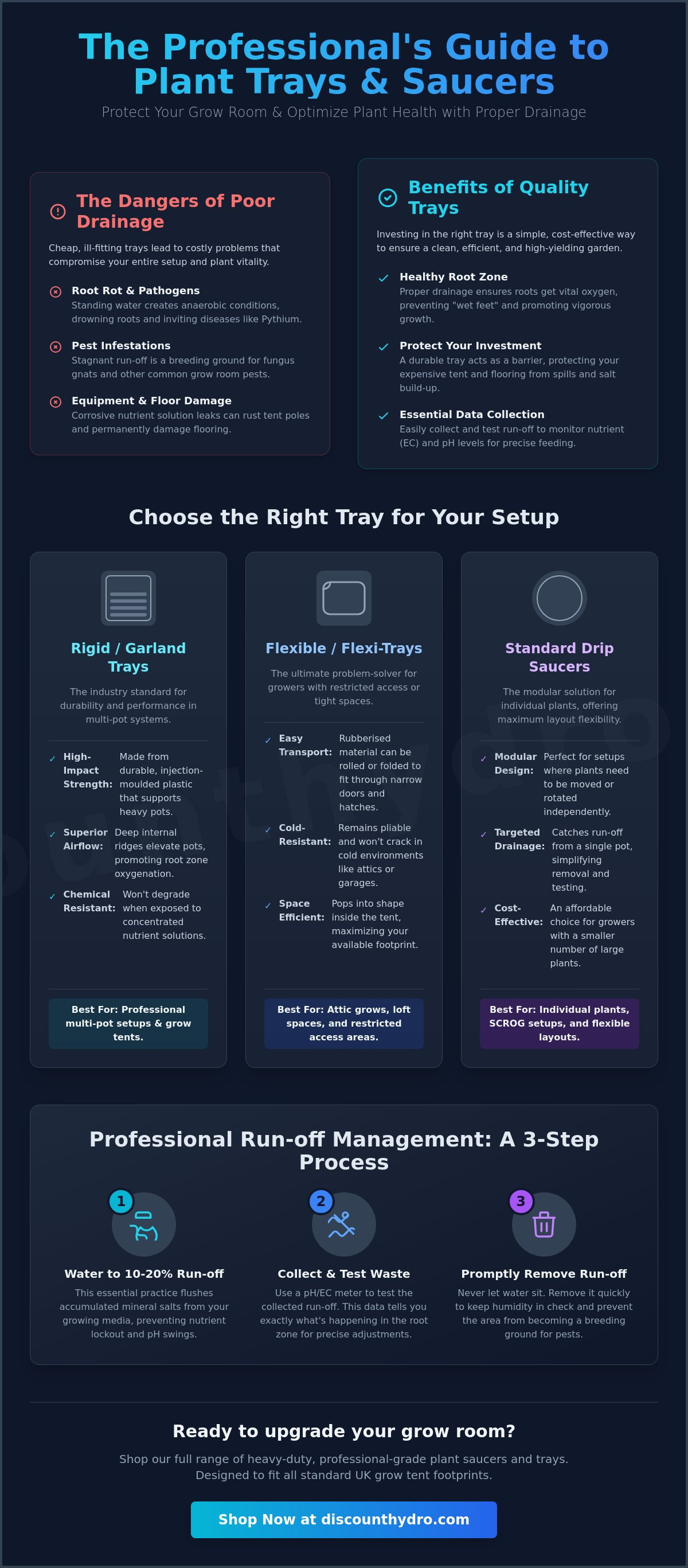
Professional growers typically water to achieve a 10% to 20% run-off. This process flushes out accumulated mineral salts from the growing media to prevent nutrient lockout and pH swings. Without a reliable tray, this waste liquid ends up on your tent floor or absorbed into your fabric pots. High-quality plant saucers and trays make it easy to remove this waste nutrient solution before it evaporates or attracts fungus gnats. Keeping the root zone clear of "wet feet" is the most effective way to maintain plant health and high yields.
Protecting Your Investment: Tents and Flooring
A grow room setup represents a significant financial investment. Nutrient-rich water is highly corrosive. If left to sit on grow tent liners, it can eventually seep through and damage the flooring underneath. Salt build-up on tent poles leads to rust and structural failure over time. A plant saucer acts as a barrier that prevents nutrient salts from staining surfaces.
Investing in a durable tray is a simple cost-benefit decision. A heavy-duty tray costs a fraction of the price of a full floor repair or a new grow tent. Beyond protection, these trays also help manage humidity. As run-off sits in the tray, it evaporates, naturally raising the moisture levels in the air. This is beneficial during the vegetative stage, provided the water is cleared regularly to prevent pests. Maintaining a dry environment outside the pot is just as important as keeping the roots hydrated inside the pot.
Comparing Different Types: Drip Trays, Garland Trays, and Flexi Trays
Selecting the correct hardware depends on your specific tent footprint and pot volume. UK indoor growers generally choose from three primary architectures: individual drip saucers, rigid Garland-style trays, and flexible rubberised trays. Each serves a specific purpose in a high-performance hydroponics setup. Using the wrong material leads to cracks, leaks, and equipment damage.
Durability is the main differentiator between professional gear and budget alternatives. Rigid injection-moulded plant saucers and trays are built to withstand the weight of saturated growing media. Vacuum-formed trays are cheaper but significantly thinner. They often fail at the corners after a few months of use. Professional-grade plastic is chemical-resistant, ensuring it won't degrade when exposed to concentrated nutrient solutions.
Rigid Garland and Drip Trays
These workhorse trays are the industry standard for multi-pot systems. Brands like Garland are manufactured in the UK, offering high-impact strength that supports dozens of smaller pots or several large ones. These trays feature deep internal ridges. These channels are vital for airflow. They keep the base of the pot elevated, adhering to established horticulture principals that prioritize root zone oxygenation. Individual drip saucers are better for modular setups where you need to move plants independently.
Flexible Trays for Tight Spaces
Flexi-trays provide a unique advantage for growers working in restricted environments. Rigid trays are often impossible to fit through narrow grow room doors or loft hatches. A flexible tray uses a rubberised material that you can fold or roll for transport. Once inside the tent, it pops back into its original shape. These are ideal for attic grows where temperatures fluctuate. The rubberised material remains pliable and won't crack in cold environments, unlike some rigid plastics. If you're managing a tight space, you can find flexible trays designed to fit standard tent footprints perfectly.
These pliable options are superior when you need to cover every inch of a tent floor. They can be slightly compressed to fit perfectly against the tent poles. This maximizes your growing area while ensuring 100% spill protection. Rigid trays, while more stable for moving pots around, require exact measurements to avoid wasting floor space. Mixing and matching these types allows you to customize your drainage based on the specific needs of your grow room layout.
Selecting the Right Size and Material for Your Pots
Selecting plant saucers and trays requires more than a visual guess. You must match the tray's internal base diameter to the widest part of your pot's bottom. For fabric pots, add 2cm to 3cm extra to account for the pot's tendency to bulge when saturated. The "lip" height is another vital metric. Deep trays with a 5cm to 10cm rim are better for high-volume feeding. They catch large amounts of run-off without overflowing, which is essential if you use automated irrigation systems. Square pots in square trays maximize every square inch of your grow room. Round saucers often leave dead space in the corners of a tent. If your goal is a high-density canopy, stick to square configurations.
Sizing Your Trays for Grow Tents
UK grow tents follow standard dimensions. A 60cm x 60cm tent is best served by a single 55cm square tray or individual saucers. For a 1.2m x 1.2m tent, a 1m or 1.2m "wall-to-wall" tray provides maximum floor protection. This method ensures any spill is contained within the waterproof liner. Always leave a few centimetres of "finger room" between the tray edge and the tent poles. This allows you to remove the tray for cleaning without dismantling your entire setup. If you use a 1m x 1m tent, a 100cm Garland tray is the most efficient choice for coverage.
Material Matters: PVC, Polypropylene, and BPA Concerns
The intensity of modern led grow lights can degrade cheap plastics quickly. UV-stabilised polypropylene is the industry standard. It won't become brittle or crack under high-intensity light. If you're growing plants for consumption, use food-grade, inert plastics. Cheap, non-inert plastics can off-gas harmful VOCs when exposed to the heat and light of a professional environment. For large 20L+ pots, ensure the plastic thickness is at least 3mm. Thin trays will bow and crack under the weight of wet growing media. Durable plant saucers and trays made from high-density polyethylene are often the best choice for long-term reliability in humid grow rooms.
Managing Nutrient Run-off and Maintaining a Clean Environment
Proper use of plant saucers and trays goes beyond catching spills. It's about data. Every time you feed your plants, the liquid that drains out contains vital information about what's happening in the root zone. Leaving this water to sit for days is a common mistake. It leads to salt re-absorption, which spikes the EC (electrical conductivity) and stunts growth. You should empty your trays after every feeding session once the drainage stops. For large trays where lifting pots isn't practical, use a large syringe or a dedicated wet-vac to remove the waste. This keeps the environment dry and the root zone oxygenated. A clean tray prevents the "wicking" effect where the pot sucks up dirty, salt-heavy water back into the media.
Testing Your Run-off for Better Yields
To get the best results from your hydroponic nutrients, you must monitor the output. Start by watering until you see roughly 15% run-off in the saucer. Collect a sample from the tray immediately using a clean pipette. If the EC in the tray is significantly higher than the solution you poured in, your plants are under-drinking or salts are building up. For example, if you feed at 1.2 EC and the run-off is 2.5 EC, your media is too salty. You need to flush the media with a lower-strength solution immediately. Testing the pH of water in your tray is the best way to catch root zone issues early. A sudden drop in pH often signals the start of root rot or a microbial imbalance before the plant shows visible stress.
Preventing Pests and Algae
Stagnant water is an invitation for trouble. Never leave waste solution in your plant saucers and trays for more than 24 hours. Light hitting the nutrient-rich water will trigger algae growth, which consumes oxygen and attracts pests. Fungus gnats and spider mites thrive in humid, dirty environments with standing water. Between every grow cycle, sterilise your hardware. A mild hydrogen peroxide solution, roughly 3% concentration, is the most effective way to kill pathogens without leaving toxic residues. Scrub the corners of the trays where salt crusts tend to form. These crusts act as a buffer for pH, making your future readings inaccurate. If you notice a green film on your trays, your light intensity is too high for the amount of standing water present. Speed up your removal routine to break the cycle. A dry tray is a pest-free tray.
Maintaining a sterile environment is easier with the right equipment. Browse our range of heavy-duty trays and drainage tools to upgrade your setup today and keep your grow room professional.
Shop Professional Plant Trays and Saucers at Discount Hydro
Discount Hydro is the primary specialist for heavy-duty grow room hardware in the UK. We don't stock decorative garden accessories. Instead, we focus on high-impact plant saucers and trays designed for the specific rigours of indoor cultivation. Our inventory includes industry-standard Garland trays and rubberised Flexi trays that meet the requirements of professional environments. Every product in our catalogue is selected for its durability and value. We ensure that our prices remain competitive by operating as a high-volume digital warehouse. This approach allows us to offer professional-grade equipment at rates that general retailers cannot match.
Why Buy From a Specialist Hydroponics Shop?
Buying from a specialist ensures your hardware is fit for purpose. General garden centres often stock thin, vacuum-formed plastic that fails under the weight of saturated 20L pots. Our plant saucers and trays are curated for structural integrity. We understand the technical side of pot-to-tray compatibility. Whether you're using square plastic pots or fabric "air" pots, we provide the exact dimensions to maximise your tent floor space. Our staff knows that a 1.2m tray must fit inside a 1.2m tent without bending the poles. We focus on quality at competitive prices, providing the reliable hardware you need to manage run-off and protect your flooring. You won't find better value for heavy-duty UK-made Garland products elsewhere.
Fast UK Delivery and Expert Support
Logistics are a priority for our team. We operate out of County Durham, providing a convenient click-and-collect option for local growers. For those across the rest of the UK, we offer nationwide delivery. We understand that large plastic trays are prone to damage during transit if handled poorly. Unlike mass-market marketplaces, we use reinforced packaging to ensure your order arrives in perfect condition. We never ship fragile items without adequate protection. Every order of grow room accessories is sent in discreet packaging to maintain your privacy. This is a standard part of our service, not an optional extra. You get the gear you need, when you need it, without the risk of damaged equipment or unwanted attention.
We stock sizes specifically tailored for the UK hydroponics market. This means you don't have to settle for "close enough" measurements that leave gaps in your grow tent. Our inventory is always live, and our prices are updated daily to reflect the best value in the industry. If you're ready to upgrade your drainage system or protect your equipment from salt damage, we have the stock ready for immediate dispatch.
Browse our full range of pots, trays, and systems here to find the right fit for your grow room today.
Optimise Your Grow Room Drainage Management
Maintaining a professional indoor garden requires more than just high-quality lights and nutrients. It's about controlling the environment from the floor up. Mastering your run-off management with the right plant saucers and trays prevents root rot, salt build-up, and structural damage to your grow tent. By selecting durable materials like UV-stabilised polypropylene and matching them to your specific tent footprint, you ensure a dry, clean, and efficient growing space.
Discount Hydro is your specialist UK hydroponics retailer, offering heavy-duty hardware designed for the rigours of modern cultivation. We stock professional-grade Garland and Flexi trays that fit standard UK tent sizes perfectly. You can rely on our fast nationwide delivery or choose click and collect from our County Durham location. Our focus remains on providing industrial-strength equipment at competitive prices to help you protect your investment.
Ready to upgrade your setup? Shop Heavy-Duty Plant Saucers and Trays at Discount Hydro and keep your grow room performing at its peak. Your plants will thrive in a cleaner, more controlled environment.
Frequently Asked Questions
Do I really need a saucer for every plant pot?
You need a saucer for every pot unless you're using a large, multi-pot tray to cover your entire floor space. Individual saucers prevent run-off from leaking onto your grow tent liner or flooring. They also allow you to move specific plants for inspection or maintenance without creating a mess. If your pots are on a raised bench, a single large tray under the bench is often more efficient than dozens of individual saucers.
How much bigger should a plant tray be than the pot?
Choose a tray that is at least 2cm to 5cm wider than the base diameter of your pot. This extra space provides room to collect run-off without the pot sitting in a tight seal. For fabric pots, go slightly larger, as they expand when wet. A tray that is too small will overflow quickly during heavy feeding sessions, while a tray that is too large wastes valuable floor space in your tent.
Can I leave my plants sitting in the run-off water in the tray?
Never leave plants sitting in stagnant run-off water for more than 30 minutes. The root zone needs oxygen to function properly. Standing water creates anaerobic conditions that lead to Pythium and other root diseases. Additionally, plants will re-absorb the concentrated nutrient salts from the run-off, which causes nutrient burn and pH imbalances. Always use a syringe or wet-vac to clear plant saucers and trays after every feeding session.
What is the best material for a heavy-duty plant tray?
UV-stabilised polypropylene is the industry standard for professional indoor growing. This material is thick enough to support heavy pots without bowing and won't become brittle under intense lighting. High-density polyethylene is another reliable option. Avoid cheap, thin vacuum-formed plastics found in general gardening shops. Professional-grade materials are also chemical-resistant, so they won't degrade when exposed to concentrated nutrient solutions or sterilising agents.
How do I clean mineral salt deposits off my plastic plant trays?
Use a diluted citric acid solution or a 3% hydrogen peroxide wash to break down white mineral crusts. These deposits are concentrated nutrient salts that build up over time. Scrub the tray with a stiff brush and rinse thoroughly with clean water. Regular cleaning is vital because these salt deposits can act as a buffer, making it difficult to get an accurate pH reading from your run-off samples.
Are flexible plant trays as durable as rigid plastic ones?
Flexible trays are highly durable because they won't crack or shatter if dropped or stepped on. They're made from a rubberised material that withstands temperature fluctuations better than some rigid plastics. While rigid Garland trays offer more stability for moving pots, flexi-trays are superior for fitting into tight spaces or through narrow loft hatches. Both options provide 100% water containment when used correctly within their weight limits.
What size tray do I need for a 1.2m x 1.2m grow tent?
A 120cm x 120cm tray provides wall-to-wall coverage for a standard 1.2m tent. This ensures every drop of run-off is contained. If you need space for fans or heaters on the floor, a 100cm x 100cm tray is a better choice. This leaves 10cm of clearance around the edges for cables and equipment. Always measure the internal dimensions of your tent before purchasing plant saucers and trays to ensure a perfect fit.
Can I use a tray without drainage holes for bottom-watering?
You can use a solid tray for bottom-watering by filling it with a few centimetres of nutrient solution. The growing media will draw the water up through capillary action. However, this method requires careful monitoring. You must ensure the media doesn't stay oversaturated for too long. After the plant has finished taking up water, you should remove any remaining liquid to prevent the roots from becoming waterlogged and to avoid pest infestations.