

Preventing Powdery Mildew in High Humidity: The Indoor Grower’s Guide
Your grow room's white patches aren't just a hygiene failure; they're a direct result of failing to manage your Vapor Pressure Deficit (VPD). When you're preventing powdery mildew in high humidity, simply cleaning your trays isn't enough. It's frustrating to watch a promising harvest rot away while your electricity bill climbs from running inefficient equipment. With the EPA's May 2026 Fungicide Strategy changing how products are labeled, professional environmental control is more critical than ever. You need tools that work without the confusing advice often found in hobbyist forums.
You want a mildew-free harvest and a grow room that stays within safe parameters. We'll show you how to safeguard your indoor crops by mastering airflow, extraction, and environmental control in high-humidity settings. This guide previews the specific equipment and climate management techniques that actually work. You'll learn how to leverage high-quality grow tents, specialized nutrients, and advanced lighting systems to maintain your crop's health and ensure your facility remains profitable and efficient.
Key Takeaways
- Achieve a full grow room air exchange every 60 seconds to remove moisture and prevent stagnant air pockets.
- Maintain specific Vapor Pressure Deficit (VPD) levels to ensure the environment remains hostile to fungal pathogens.
- Implement bottom-up pruning and strict tool sterilization as a primary defense for preventing powdery mildew in high humidity.
- Upgrade to smart fan controllers and high-precision hygrometers to automate humidity management and track dangerous night-time spikes.
Understanding Powdery Mildew in High Humidity Environments
Powdery mildew is an obligate parasite. It requires live plant tissue to survive and reproduce. Unlike grey mold or root rot, it doesn't need liquid water on the leaf surface to germinate. High relative humidity (RH) provides enough moisture for infection to take hold. This makes preventing powdery mildew in high humidity a constant challenge for indoor growers using grow tents and high-intensity LED grow lights. Common host plants in these environments include cucumbers, bell peppers, and various ornamental flowers. The fungus belongs to the taxonomic family of powdery mildews, which are specialized to thrive in stable, warm temperatures where moisture levels remain high.
Most fungi are opportunistic, but this pathogen is aggressive. It doesn't wait for a plant to become stressed or damaged. It extracts nutrients directly from the host's cells, eventually reducing yields and killing the foliage. Because it thrives in the same temperature ranges as most indoor crops, environmental control is your only real defense. If your grow room's RH levels regularly exceed 60%, the risk of an outbreak increases significantly. This is especially true when using organic growing media that retains high levels of moisture near the plant base.
The Spore Life Cycle: From Landing to Infection
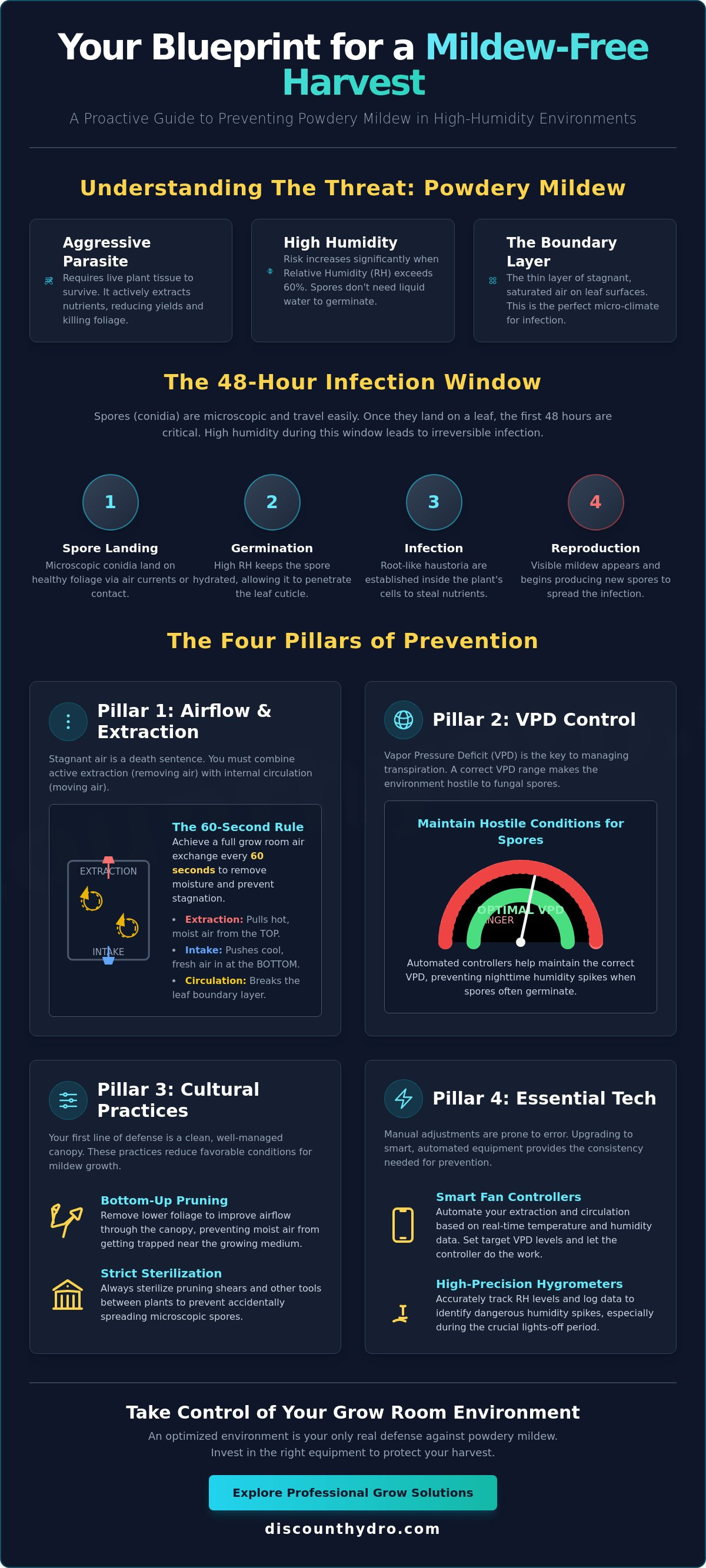
Spores, known as conidia, are microscopic and highly mobile. They travel through your ventilation system or on your clothing and land on healthy foliage. The first 48 hours after landing are critical. During this window, humidity levels dictate whether the spore successfully penetrates the leaf cuticle. High RH allows the spore to stay hydrated while it sends out infection pegs. Once the fungus establishes its root-like structures (haustoria) inside the plant, it's there to stay. Dropping the humidity after the infection has taken hold won't kill the pathogen. It only slows the production of new spores. This is why consistent environmental monitoring is more effective than reactive treatments.
Why High Humidity is the Primary Trigger
The "boundary layer" is the most dangerous zone in a grow room. This is the thin layer of still air directly on the leaf surface. When room humidity is high, this layer becomes saturated. Stagnant air creates a perfect micro-climate for hyphae growth. Without proper extraction and high-velocity fans, moisture stays trapped against the plant. Identifying early symptoms is difficult. Initial white spots can look like the damage caused by spider mites or even hard water stains from foliar feeding. However, powdery mildew quickly develops into a distinctive flour-like coating. Effective prevention starts with breaking this boundary layer and managing the moisture levels in the air through aggressive extraction.
Optimising Grow Room Airflow and Extraction
Many growers think a few clip fans are enough. They're wrong. Circulation moves air inside the space, while extraction removes moist, stale air out of the building. To succeed in preventing powdery mildew in high humidity, you must do both. Stagnant air is a death sentence for your crop. Without constant exchange, the humidity produced by plant transpiration builds up until the air can't hold any more moisture. This leads to condensation on the leaves, creating the exact environment spores need to thrive.
The standard rule of thumb is a full air exchange every 60 seconds. If your tent is 4x4x8 (128 cubic feet), you need an extraction fan capable of moving at least 128 CFM after accounting for the resistance of a carbon filter. This ensures that the humid micro-climate around the leaves never has time to settle. Research on Managing Powdery Mildew in Greenhouses shows that humidity spikes, especially during the transition from day to night, are the primary drivers of spore germination. High-performance extraction is the only way to vent that moisture before it settles on your foliage.
The Role of Extraction Fans in Humidity Control
Heat and moisture rise. Always pull air from the top of your grow tent to maximize efficiency. In high-density setups, passive intake vents might not be enough. Consider an active intake fan at the bottom to force fresh, dry air into the canopy. This creates a pressurized system that leaves no room for stagnant pockets. If you're building a new setup, browse our high-CFM extraction kits to find a match for your space.
Circulation Fans: Breaking the Boundary Layer
Circulation fans should create a gentle cross-breeze. Don't point high-velocity fans directly at the foliage. This causes wind burn, which damages the leaf cuticle and makes it easier for pathogens to enter. Instead, position oscillating fans in corners to eliminate dead spots where spores accumulate. Ensure at least one fan is positioned to move air beneath the canopy. Moisture often builds up at the soil level in large pots or trays. Keeping the air moving near the growing media is a vital step in preventing powdery mildew in high humidity environments, as it prevents the bottom-up infection pattern common in humid rooms.
Use a carbon filter on your intake if your external environment is high-risk. Spores are airborne and travel easily. Filtering the air before it enters your tent keeps the pathogen count low from day one. Combine this with a high-quality extraction system for a truly mildew-resistant environment.
Controlling Vapor Pressure Deficit (VPD) to Stop Spore Germination
Vapor Pressure Deficit (VPD) is the mathematical difference between the amount of moisture in the air and how much moisture that air can hold at its saturation point. For professional indoor growers, mastering this metric is the most effective method for preventing powdery mildew in high humidity. A low VPD occurs when the air is nearly saturated, which typically happens in cool, damp rooms. This environment stops plants from transpiring correctly and allows fungal spores to hydrate and germinate on the leaf surface. If your VPD stays too low for extended periods, your crop is essentially a sitting duck for infection.
Taking Proactive steps to avoid mildew requires moving beyond simple humidity readings. You need to understand the direct relationship between temperature and moisture. When your VPD is too low, the plant's natural defense mechanisms slow down because it can't move nutrients effectively through transpiration. By using a standard VPD chart, you can identify the exact "safe zone" for your specific growth stage. This ensures the air is dry enough to inhibit pathogens while remaining moist enough for healthy plant development.
The "Dew Point" represents the greatest danger to your harvest. This is the temperature at which air can no longer hold its water vapor, causing it to condense into liquid. This usually happens during the lights-off transition. If your room temperature drops quickly while the air is still humid from the day's activity, water will form on your leaves. This microscopic film of water provides the perfect bridge for a spore to infect your foliage. Maintaining a tight temperature gap between day and night cycles is a mandatory requirement for preventing powdery mildew in high humidity environments.
Managing the Night-Cycle Humidity Spike
Humidity levels always rise when lights go out. Cooler air has a lower moisture capacity; the same amount of water vapor results in a much higher Relative Humidity (RH) percentage. Don't let your extraction fans idle during this period. Running your extraction at 100% for the first hour of darkness clears out the moisture-heavy air left over from the light cycle. Using small heaters to maintain a stable lights-off temperature prevents the air from reaching the dew point and keeps your VPD within the safe range.
Dehumidification Strategies for UK Growers
UK climates often feature high ambient humidity before the air even enters your building. If increasing fan speed doesn't lower your RH, you need a standalone dehumidifier. Position these units outside your tent's intake for maximum efficiency. Modern LED grow lights run significantly cooler than traditional HPS lamps. While this saves on cooling costs, it leads to lower room temperatures and higher RH. You must compensate for this by adding supplemental heat or using more aggressive dehumidification to maintain a healthy environment.
Cultural Practices and Foliar Prevention Strategies
Mechanical environmental control is only half the battle. Your plant's physical structure and nutritional health determine its baseline resistance. In the context of preventing powdery mildew in high humidity, cultural practices act as your secondary line of defense. The bottom-up pruning method is essential. By removing the lowest third of fan leaves, you eliminate the primary humidity traps where spores first take hold. These lower leaves often sit in stagnant air near moist growing media, making them the most vulnerable part of the plant.
Your feeding schedule also impacts fungal vulnerability. Over-feeding nitrogen creates "soft" plant tissue. This lush, watery growth is significantly easier for fungal hyphae to penetrate than firm, well-developed foliage. Balance your nitrogen intake with high levels of silica. Silica isn't just a supplement; it physically strengthens plant cell walls. A plant with a high silica content develops a literal armor against pathogens, making it much harder for spores to establish a colony even when humidity levels are high.
Defoliation and Spacing for Maximum Air Penetration
Congested canopies trap moisture through transpiration. Use the "lollipop" technique to clear out the inner and lower branches that don't receive direct light. This forces airflow through the center of the plant. Ensure your pots aren't touching. Air must move freely around the root zone and the lower stems to prevent moisture build-up. Spores are hitchhikers. Implement a strict sterilization protocol for your tools, boots, and clothing. If you've been outside or in another grow space, change your clothes before entering your clean room. A simple 10% bleach solution or isopropyl alcohol on your pruning shears prevents the cross-contamination that ruins entire harvests.
Preventative Sprays and Nutrient Boosters
Integrating potassium silicate into your hydroponic nutrients regime is a proactive way to build systemic resistance. Beyond the reservoir, foliar sprays can make the leaf surface inhospitable. Sprays that alter the surface pH, such as potassium bicarbonate, prevent spores from germinating. Apply these preventatives during the early vegetative stage. Avoid heavy foliar applications during late flowering, as trapped moisture in dense floral clusters can lead to botrytis. If you need to strengthen your plants today, check out our selection of specialized silica supplements and plant washes to fortify your crop against infection.
Consistency is key. A single day of neglected pruning or a missed sterilization step can provide the opening the fungus needs. By combining these cultural habits with the VPD management discussed in previous sections, you create a multi-layered defense system that makes preventing powdery mildew in high humidity a manageable part of your routine rather than a constant crisis.
Essential Equipment for a Mildew-Free Grow Room
Investing in professional-grade hardware is the most reliable way of preventing powdery mildew in high humidity. Cheap equipment fails when environmental stress is highest. You need high-quality hygrometers that feature min/max memory. These devices allow you to track the exact humidity levels during the night cycle when you aren't present to monitor the room. If your memory shows a spike of 85% RH at 3 AM, you know your current extraction is insufficient. Smart fan controllers take this a step further by automatically adjusting fan speeds in response to real-time humidity and temperature changes. This automation removes human error from the equation.
Your choice of growing method also impacts ambient moisture. Using hydroponics can actually help control evaporation better than traditional soil. In a closed hydroponic system, the nutrient solution is contained. This reduces the amount of moisture that evaporates directly into the air from the surface of large soil pots. This makes it easier to maintain a stable VPD. While the initial investment in a larger extraction system might seem high, it saves money by preventing the total loss of a harvest. A single failed crop often costs more than the price of a high-capacity EC fan and carbon filter kit.
Monitoring Tools: You Can’t Manage What You Can’t Measure
Sensor placement is critical for accurate data. Don't just hang your hygrometer on the wall. Place sensors directly at the canopy level where the plants transpire. This is where the humidity micro-climate is most dense. Use data loggers to identify the exact moment humidity peaks so you can program your equipment to compensate. Calibrate your equipment every few months. High-moisture environments can cause sensor drift over time. This leads to inaccurate readings that put your crop at risk.
Choosing the Right Extraction and Filtration
Precision speed control is the main advantage of EC fans over older AC models. EC fans allow for minute adjustments in airflow. This is vital for maintaining a consistent VPD. Oversized fans running at 50% speed are quieter and more energy-efficient than small fans running at 100%. They also provide a power reserve for those humid summer days when your room needs maximum venting. Use this final checklist for your setup:
- High-CFM EC Fan: Sized for at least one full air exchange per minute.
- Smart Controller: To automate fan response to RH spikes.
- Canopy-Level Sensors: For localized humidity monitoring.
- Sealed Hydroponic Trays: To minimize surface evaporation.
- Industrial Carbon Filter: To keep intake air free of external spores.
By prioritizing these tools, preventing powdery mildew in high humidity becomes a function of your equipment rather than a daily struggle. A well-equipped room maintains itself. This allows you to focus on plant health and yield optimization.
Secure Your Harvest with Professional Climate Control
Mastering your indoor environment is the only way to ensure a consistent, mildew-free harvest. Success in preventing powdery mildew in high humidity depends on the synergy between high-performance extraction and precise nutrient management. By maintaining a stable Vapor Pressure Deficit and fortifying your plants with silica, you eliminate the stagnant micro-climates where fungal pathogens thrive. Don't wait for white spots to appear before upgrading your setup; reactive treatments are costly and often arrive too late to save your yields.
As a specialist supplier, we provide the hardware and supplements required to keep your grow room within safe parameters. We are stockists of Omega Lighting and Intense Nutrients, offering UK-wide fast delivery and specialist advice for indoor growers. Browse our range of high-performance extraction fans and dehumidifiers to secure your grow space against environmental threats. You've got the knowledge to maintain a stable, productive environment; now get the tools that make it possible.
Frequently Asked Questions
Does high humidity always cause powdery mildew?
High humidity doesn't cause the fungus spontaneously; it requires the presence of spores and a live host plant. However, moisture levels above 60% RH create the ideal conditions for dormant spores to activate. Without these high-moisture triggers, spores often remain inactive. Environmental control is your first line of defense for preventing powdery mildew in high humidity environments where spores are likely present.
Can I use a domestic dehumidifier in a grow tent?
You can use a domestic dehumidifier, but they often struggle with the high transpiration rates found in dense canopies. Standard household units aren't designed for the constant moisture output of multiple large plants. They also generate significant heat, which can negatively impact your VPD. For consistent results, professional-grade units or increased extraction speeds are usually more effective and energy-efficient choices for indoor growers.
What is the ideal humidity for preventing mildew during the flowering stage?
Maintain a Relative Humidity (RH) between 40% and 50% during the flowering stage. This range is low enough to inhibit spore germination while still allowing for healthy plant development. As flowers become denser, they trap more moisture, increasing the risk of internal rot. Keeping your extraction fans running at higher speeds during this phase ensures that humid air is removed before it can settle within the canopy.
Is it possible to cure powdery mildew once it appears on the leaves?
You cannot cure a systemic infection, but you can suppress the visible symptoms and stop the spread. Once the fungus establishes its root system inside the leaf tissue, it remains there for the life of the plant. Fungicides and pH-altering sprays only kill the external spores and hyphae. Success in preventing powdery mildew in high humidity relies on early intervention and removing heavily infected foliage to protect the rest of your crop.
Why does my humidity spike when the grow lights turn off?
Humidity spikes because cooler air has a lower capacity to hold water vapor. When your LED grow lights turn off, the temperature drops, causing the Relative Humidity to rise even if the actual amount of water in the air stays the same. This often pushes the environment toward the dew point. To counter this, keep your extraction fans active and use supplemental heating to maintain a stable lights-off temperature.
Does running oscillating fans 24/7 prevent fungal growth?
Continuous airflow helps by breaking the boundary layer of moisture on the leaf surface, but it won't stop a mildew outbreak on its own. Fans move air around, but they don't remove moisture from the room. If your ambient humidity remains high, spores will still germinate. You must combine 24/7 circulation with mechanical extraction to effectively vent the humid air out of your grow space and maintain a healthy VPD.
Are some plant varieties more resistant to powdery mildew than others?
Genetic resistance varies significantly between different plant species and cultivars. Some varieties of cucumbers and ornamental flowers have been bred specifically to resist fungal pathogens. These plants often have thicker leaf cuticles or different surface pH levels that make it harder for spores to attach. While genetics provide a baseline defense, even resistant varieties will eventually succumb if your grow room environment is consistently damp and stagnant.
Will a carbon filter stop powdery mildew spores from entering my tent?
A carbon filter can act as a physical barrier against spores if it's installed on your intake fan. Most spores are between 2 and 10 microns in size, which a high-quality filter can trap before they reach your plants. This is a pragmatic choice for growers in areas with high external fungal counts. Ensure your filters are changed regularly, as clogged mesh reduces airflow and increases the humidity within your tent.