

10 Common Grow Tent Setup Mistakes to Avoid in 2026
Last October, a hobbyist in Manchester spent over £850 on high-end LED lights and nutrients, only to lose the entire crop to heat stress and stagnant air within just 14 days. It's a common and expensive reality because even minor grow tent setup mistakes to avoid can lead to wasted electricity and a total harvest failure. You likely understand that building a productive indoor garden requires more than just buying the most expensive kit on the shelf; it's about how every component works together.
We agree that the fear of electrical faults or noise bothering your neighbours can make the initial setup feel overwhelming. This article will help you master your indoor environment by identifying and fixing the specific errors that compromise plant health and yield. You'll learn how to manage ventilation, secure your electrical connections, and use quality UK-sourced equipment to create a safe, discreet, and high-yielding space. We'll preview ten critical areas, including light height calibration and odour control, to ensure your 2026 grow is your most successful yet.
Key Takeaways
- Learn why selecting the correct size and avoiding uninsulated UK lofts is essential for maintaining stable environment temperatures.
- Discover how to identify and fix common grow tent setup mistakes to avoid, such as using inadequate desk fans instead of proper extraction systems.
- Protect your home and equipment by following vital electrical safety protocols, including the correct use of UK-rated extension leads.
- Ensure a discreet and healthy garden by mastering odour control and implementing hygiene practices to keep pests like spider mites at bay.
- Maximise your final yield by performing a full equipment "dry run" and calibrating your pH and EC meters before you begin.
Foundation Failures: Choosing the Wrong Size or Location
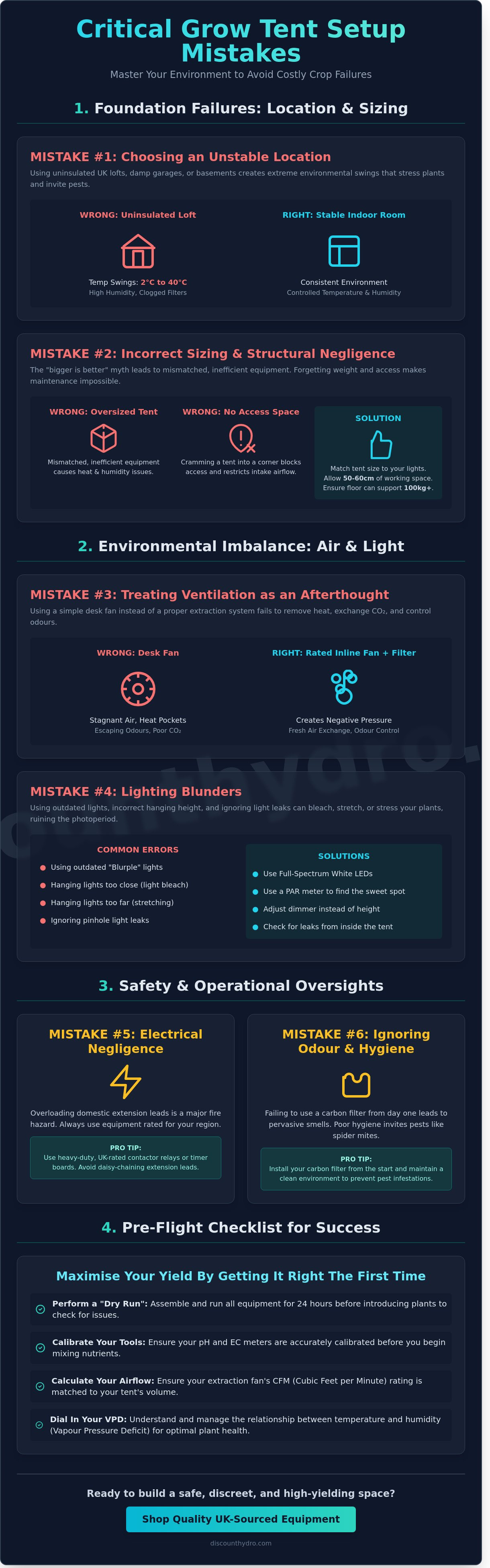
Choosing the correct spot for your indoor garden is the first step toward a successful harvest. One of the most common grow tent setup mistakes to avoid is the "bigger is better" trap. New growers often purchase a 2.4m x 2.4m tent without considering the electricity costs or the massive extraction fans needed to clear that volume of air. If your lighting and ventilation don't match the tent's cubic capacity, you'll face constant heat and humidity issues. Start by understanding grow box systems and how they isolate internal environments from the rest of your house before you commit to a specific footprint.
Location is equally vital. Placing a tent in an uninsulated UK loft is a recipe for disaster. Temperatures in a typical British attic can plummet to 2°C in January and soar to 40°C during a summer heatwave. You also need to account for "working space" around the exterior. You'll need at least 50cm to 60cm of clearance on at least two sides to access side zips and port holes. Shoving a tent into a tight corner makes maintenance impossible and restricts airflow to your intake fans.
Don't overlook the structural integrity of your floor. A 1.2m tent containing four 25-litre pots filled with wet coco coir can easily weigh over 100kg. When you add the weight of the grower and the equipment, older floorboards in Victorian terraces may groan under the pressure. Ensure your chosen spot is level and capable of supporting a concentrated heavy load for months at a time.
The Problem with Unstable Environments
External conditions dictate internal success. A garage might seem ideal, but managing the dampness of a County Durham winter is a massive challenge. When external humidity hits 90%, your internal carbon filters will clog and fail. Avoid placing your tent directly next to a radiator, which creates localized hotspots, or a draughty window that causes sharp temperature drops at night. These fluctuations stress plants and invite pests.
Sizing Your Tent to Your Equipment
Your tent height must accommodate your lighting. Modern LED grow lights often require 30cm to 50cm of "hang height" above the plant canopy. If you buy a short 1.6m tent, your plants will quickly outgrow the space, leading to light burn. Overcrowding is another major issue; squeezing six plants into a space meant for four leads to poor air circulation and mould. Check our grow tent guide to ensure your dimensions allow for easy access and proper plant spacing. This prevents the humid "microclimates" that ruin crops just before harvest.
Environmental Imbalance: Ventilation and Lighting Blunders
Setting up a tent isn't just about assembly; it's about atmosphere. One of the biggest grow tent setup mistakes to avoid is treating ventilation as an afterthought. A 15cm desk fan isn't an extraction system. It won't swap stale air for fresh CO2 or remove heat. You need an inline fan rated specifically for your tent's volume to maintain a healthy cycle.
Ventilation and Airflow Mistakes
Proper extraction requires a higher CFM (Cubic Feet per Minute) for extraction than your intake. This creates negative pressure, which stops odours from escaping through zips or seams. If you don't use a carbon filter from day one, you'll soon regret the smell as it permeates your living space. Poor airflow creates "hot spots" that burn delicate leaves, with temperatures often spiking 5°C above the ambient room level. For more indoor gardening tips on managing these environmental factors, look to agricultural research.
LED Lighting Misconceptions
Many growers still use outdated "blurple" lights instead of full-spectrum white LEDs. PAR (Photosynthetically Active Radiation) is the true measure of light efficiency. Modern LED grow lights feature dimming functions that allow you to adjust intensity without constantly moving the fixture. Hanging lights too close causes light bleach, while hanging them too far makes plants stretch and lose vigour. Use a PAR meter to find the sweet spot for your canopy.
Light leaks ruin plant photoperiods. Even a pinhead-sized hole in your tent wall can cause plants to stress and revert to vegetative growth or develop seeds. Always check your zips and seams from the inside with the external lights on. Failing to calibrate your VPD (Vapour Pressure Deficit) for plant health is another common error. Without the right balance of humidity and temperature, your plants won't transpire correctly, leading to nutrient lockouts. Correcting these grow tent setup mistakes to avoid will lead to a more successful harvest. You can find high-quality ventilation kits and lighting to upgrade your system today.
Structural and Electrical Negligence: The Safety Risks
Electrical and structural failures are the most dangerous grow tent setup mistakes to avoid. These errors don't just ruin a crop; they risk your home and your safety. High-draw equipment like 600W HPS kits or large LED arrays pull significant current. Using a cheap, non-rated extension lead from a local supermarket is a major hazard. These leads aren't designed for the 12 to 18-hour constant loads required for indoor gardening. They often overheat, melt, or catch fire. Always check the amp rating on every cable and plug in your system to ensure they can handle the continuous wattage.
Electrical Safety in the Grow Room
UK growers must prioritise safety by using a Residual Current Device (RCD) adapter. These units cut power in less than 40 milliseconds if they detect a circuit imbalance. This is vital in a room where water and high-voltage electronics sit in close proximity. Never "daisy-chain" power strips. Plugging one multi-way lead into another creates excessive resistance and heat at the socket. Keep your cables organised with Velcro ties. Organising wires prevents tripping hazards and keeps them away from potential leaks. Mount ballasts and drivers on a brick wall or a dedicated shelf outside the tent to keep heat away from your plants and electronics off the floor.
Weight and Balance Issues
Structural integrity is often ignored until a frame snaps. A heavy 150mm carbon filter and matching extractor fan can easily exceed 15kg. If you hang this weight directly over the centre of the plants, the roof bars will bow. This stress eventually pulls the seams apart or causes the zips to jam. Distribute the weight by securing heavy equipment as close to the corner poles as possible. Most standard 1.2m tents have a total hanging limit of 30kg to 50kg. Exceeding this limit compromises the light-tight seal of the fabric. Check the integrity of your zips weekly. If they feel tight or skip teeth, your frame is likely under too much tension from poorly balanced equipment. Use a dedicated lighting controller rather than a standard household timer. Household timers often fail under the massive "inrush current" of HID ballasts, leaving your lights on 24 hours a day and ruining your light cycles.
Operational Oversights: Odour Control and Hygiene
Setting up your environment involves more than just plugging in lights. Exhausting hot, humid air back into the same room as the tent is a critical grow tent setup mistake to avoid. This creates a heat loop that raises ambient temperatures by 5-8°C, making it impossible for your cooling system to function. You must vent air outside or into a separate room to maintain stability. Over-complicating your grow with too many hydroponic nutrients is another common pitfall. Beginners often believe more bottles mean better results; however, this usually leads to nutrient lockout and wasted money. Keep your feed schedule simple to ensure your plants actually absorb what they need.
Discretion and Odour Management
A saturated carbon filter is worse than no filter. It restricts airflow without removing smells. Replace your carbon every 12 months to ensure it actually works. Noise is a major factor for UK growers in terraced housing. A standard 6-inch fan can reach 60 decibels; use acoustic ducting to reduce this hum by 10-15 decibels. Ensure your tent has negative pressure by checking that the walls bow inward slightly. This physical seal prevents untreated air from escaping through zips or seams.
Hygiene and Pest Prevention
Pests don't just appear; you usually invite them in. Bringing outdoor tools or garden soil into a sterile environment is a fast way to introduce spider mites. These pests can destroy a crop in less than 7 days. Standing water on the floor is another magnet for trouble. It increases humidity and invites root rot. Failing to maintain a clinical environment is a common grow tent setup mistake to avoid for those seeking high yields.
- Shoes-off policy: Bacteria and pest eggs travel on the soles of your shoes; leave them at the door.
- Tool sterilisation: Clean your snips with 70% isopropyl alcohol after every single use.
- Spill management: Wipe up any nutrient spills immediately to prevent fungal growth on the tent floor.
A 2025 industry report suggested that 65% of indoor pest infestations are introduced via human contact or contaminated clothing. Keeping your workspace as clean as a laboratory is the best way to protect your investment. When your hygiene standards slip, your plant health follows closely behind.
Keep your grow environment clean and discreet by browsing our latest hydroponics equipment and extraction filters.
Optimising Your Yield: The Professional Setup Checklist
Success in hydroponics depends on precision. Many growers rush the assembly phase, but taking an extra 48 hours to verify your environment prevents the most expensive grow tent setup mistakes to avoid. Start by performing a full dry run of all equipment. Plug in your lights, extraction fans, and circulation fans for a continuous 24-hour cycle before any plants enter the space. This identifies potential equipment failure or heat spikes when the tent is sealed. It's much easier to replace a faulty ballast or a noisy fan when the tent is empty.
Precision tools are your best defence against crop failure. You must calibrate your pH and EC metres using professional buffer solutions. A deviation of just 0.5 pH can lead to nutrient lockout, which stunts growth within days. Pair this with a high-quality digital hygrometer. Ensure the device has a min/max memory function. This allows you to track humidity spikes during the dark cycle, which is when most mould issues take root. Relying on a single real-time reading won't give you the full picture of your environment's stability.
The 2026 Pre-Grow Checklist
- Verify light seals: Sit inside the tent with the zips closed and external lights on. Even a pinprick of light can disrupt plant cycles.
- Monitor vibrations: Check that fan mounts don't transfer hum through the walls. Use acoustic ducting or rubber hangers to keep noise levels below 35dB.
- Test solution stability: Aim for a nutrient temperature between 18°C and 21°C. Temperatures above 23°C significantly reduce dissolved oxygen levels.
Why Quality Gear Saves Money
Cheap equipment is a false economy. Budget tents often feature thin 210D canvas that tears easily and low-quality zips that fail under daily use. Investing in a heavy-duty 600D or 1680D tent ensures your environment remains light-tight for years. High-efficiency LED fixtures are another essential investment. Modern LEDs can offer 2.7 µmol/j or higher, which reduces electricity consumption by up to 40% compared to older HPS systems. These savings often cover the initial cost of the light within the first 12 to 18 months of operation. Buying from a reputable UK supplier ensures you receive genuine components and valid warranties. Choosing professional-grade kit is the simplest way to bypass common grow tent setup mistakes to avoid while securing a better return on your investment.
Ready to upgrade your environment? Browse our range of professional grow tent kits at Discount Hydro for the UK's best prices on high-performance gear.
Master Your Indoor Environment for 2026
Success in indoor horticulture depends on getting the basics right from day one. You've now seen the most expensive grow tent setup mistakes to avoid in 2026, such as miscalculating ventilation needs or neglecting electrical safety. Industry data indicates that poor airflow accounts for up to 40% of plant health issues in domestic environments. By prioritising hygiene and selecting the correct tent size for your floor space, you'll create a stable climate that produces consistent results. Don't let a simple oversight ruin your hard work or waste your electricity.
Stock up on professional-grade equipment to ensure your system runs at peak efficiency. We provide the UK's best prices on top brands like Omega and Intense Nutrients. Take advantage of our UK-wide fast delivery to get your room running quickly; we also offer click and collect available in County Durham for immediate pickup. We're committed to helping you find the right tools for a productive year ahead.
Upgrade your setup with our best-selling UK grow tents and LED kits
Your journey to a perfect harvest starts with a solid foundation and the right gear.
Frequently Asked Questions
Is it safe to run a grow tent in a spare bedroom in the UK?
Yes, running a tent in a spare room is safe if you respect UK electrical limits and floor loading. Ensure your 230V connections are secure and use a tray to catch any runoff. A standard 1.2m x 1.2m tent weighs about 40kg when fully equipped, which fits well within the 1.5kN/m2 domestic floor load capacity specified in UK Building Regulations.
How do I stop my grow tent from smelling outside the house?
You must use a carbon filter matched to your extractor fan's airflow to eliminate odours. This creates negative pressure, so air only leaves through the filtered exhaust. Replace your carbon pellets every 12 to 18 months. If the humidity stays above 65%, the filter's efficiency drops by 30%, so keep the air dry to maintain total scent control.
Can I use a regular extension lead for my grow lights and fans?
You shouldn't use standard household extension leads for high-intensity discharge lights. Most UK leads are rated for 13 amps, but cheap versions often overheat when run at 80% capacity for 18 hours straight. Use a heavy-duty contactor or a surge-protected power strip rated for 3,000 watts. This prevents melted sockets and helps you avoid common grow tent setup mistakes to avoid.
How much electricity does a standard grow tent setup use?
A typical 600W LED setup with extraction uses roughly 0.7 units of electricity per hour. Based on the October 2024 UK energy price cap of 24.5p per kWh, running this for 12 hours costs about £2.06 per day. Your specific costs will vary based on your tariff and whether you run fans 24/7, which adds another 50W to 100W to the total draw.
Do I really need a carbon filter if I am only growing a few plants?
Yes, a carbon filter is necessary even for two or three plants. Indoor crops produce volatile organic compounds that become pungent during the final 4 weeks of growth. Without filtration, these smells can penetrate soft furnishings and alert neighbours. Investing in a 100mm or 125mm filter kit is a low-cost way to ensure your indoor garden remains completely private and professional.
What happens if there is a power cut to my grow tent?
A power cut stops your lights, fans, and pumps immediately, which can stress your plants. Most digital timers have a battery backup, but analogue timers will lose time and throw off your 12/12 or 18/6 light cycles. If the power stays off for more than 4 hours, temperatures can drop by 10 degrees Celsius, potentially causing damp issues or stunted growth.
How often should I clean the inside of my grow tent?
You should deep clean your tent after every single harvest. Wipe the floor every 7 days to remove spilled nutrients or dust that attracts spider mites. Use a 10% bleach solution or a specialist fungicidal wash to kill 99% of pathogens. Cleaning the reflective walls ensures you don't lose 5% to 10% of your light intensity to dirt buildup.
Can I vent my grow tent into the chimney or loft space?
You can vent into a chimney, but venting into a loft requires caution. Pumping warm, moist air into a cold UK loft space often causes condensation, leading to roof timber rot within 6 months. If you must use the loft, use insulated ducting and ensure the air reaches the outside through a roof vent or soffit to prevent moisture traps.