

Mastering pH Meters for Hydroponics: The Ultimate 2026 Guide
Why are your leaves turning yellow when you've invested heavily in premium nutrients and high-output LED lights? Most growers blame the feed, but the real culprit is often an invisible shift in water chemistry that locks out essential minerals. You know that keeping your solution stable is the foundation of a successful indoor garden, yet finding a reliable ph meter for hydroponics remains a major hurdle. Fluctuating readings and low-quality equipment often lead to more frustration than clarity, putting your entire crop at risk.
This ultimate 2026 guide teaches you how to select, calibrate, and maintain the perfect meter to prevent nutrient lockout and maximize your indoor harvest. We'll break down the latest hardware options, show you how to speed up your daily testing routines, and provide the technical confidence you need for consistent, healthy plant growth. It's time to stop second-guessing your kit and start seeing the results your investment deserves. Learn the exact steps to ensure your plants can fully utilize every drop of nutrition you provide without the constant risk of equipment failure or inaccurate data.
Key Takeaways
- Identify how specific pH levels prevent nutrient lockout to ensure your plants fully utilize premium supplements and fertilizers.
- Select the right ph meter for hydroponics by understanding the critical differences between 0.1 and 0.01 accuracy ratings.
- Upgrade from manual liquid kits to digital pens for faster testing routines and more consistent reservoir readings.
- Master the essential calibration and storage steps using Buffer 4.0, 7.0, and KCI solutions to stop sensor drift and equipment failure.
- Source professional-grade testing hardware from a specialist UK supplier to guarantee fresh consumables and technical reliability.
Understanding pH and Nutrient Lockout in Hydroponic Systems
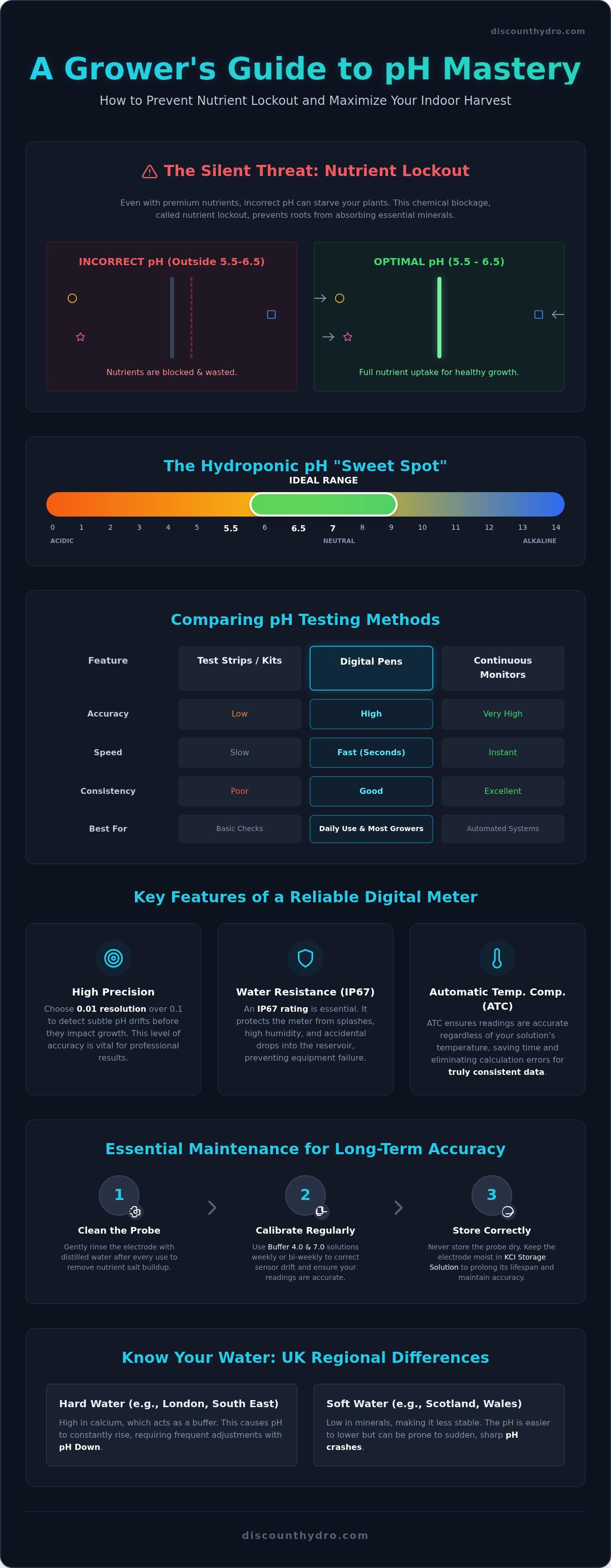
pH stands for "Potential Hydrogen." It measures the concentration of hydrogen ions in your nutrient solution on a scale of 0 to 14. A reading of 7 is neutral; anything lower is acidic and anything higher is alkaline. For most hydroponic crops, the ideal range sits between 5.5 and 6.5. Maintaining this slightly acidic environment is mandatory for plant health. If the levels drift outside this window, your plants lose the ability to absorb specific minerals. This chemical blockage is called nutrient lockout.
A precision pH meter is the only tool that provides the accuracy needed to manage these levels. pH isn't a static measurement. It fluctuates constantly as plants consume water and nutrients. For instance, if a plant absorbs more nitrogen than other elements, the solution's acidity can shift rapidly. Using a ph meter for hydroponics daily allows you to identify these drifts before they cause permanent damage to your root zone or foliage.
The Consequences of Poor pH Management
Nutrient lockout triggers rapid visible decline. Common symptoms include yellowing leaves, stunted growth, and eventually root rot. Many growers see these signs and assume they need more fertilizer. Adding more nutrients, even professional-grade options like Intense Nutrients, to a locked-out system makes the problem worse. It increases salt levels and further stresses the roots without fixing the underlying absorption issue. You must correct the pH first to restore uptake. For a full breakdown on mixing your reservoir, refer to our hydroponic nutrients guide.
Why Water Quality Matters in the UK
Your local water source determines how much maintenance your system requires. UK water varies by region, impacting how you use your ph meter for hydroponics. In hard water areas like London and the South East, high levels of calcium and magnesium carbonates act as a buffer. This alkalinity constantly pulls the pH upwards, requiring frequent adjustments with pH Down. Soft water regions, common in Scotland and Wales, have fewer minerals. While the pH is easier to lower, it can be less stable and prone to sudden crashes. Understanding these regional differences is a core part of system management. Check our hydroponics basics guide to see how water quality influences your initial system setup and hardware choices.
Key Features of a Reliable Hydroponic pH Meter
A high-quality ph meter for hydroponics isn't just a digital thermometer with a probe; it's a precision instrument designed for harsh environments. When comparing models, resolution and accuracy are the primary technical specs. A resolution of 0.1 pH is standard for entry-level gear, but professional growers often opt for 0.01 pH resolution to catch subtle drifts before they impact growth. High accuracy ensures your nutrient solution stays within the tight absorption window required for healthy root development. Understanding pH and Nutrient Lockout is vital here, as even a small inaccuracy can prevent your plants from taking up the premium nutrients you've invested in.
Water resistance is another non-negotiable feature. Look for an IP67 rating, which guarantees the device is dust-tight and can survive being dropped into a nutrient reservoir for short periods. Since grow rooms are high-humidity areas, a non-waterproof meter will likely fail within months due to internal corrosion. Investing in hardware that can withstand splashes and accidental submersion is a pragmatic choice for any indoor gardener.
The Importance of ATC (Automatic Temperature Compensation)
Temperature significantly influences the activity of hydrogen ions in your water. As the temperature of your reservoir fluctuates throughout the light cycle, the raw pH reading will shift even if the chemical composition remains the same. Meters without ATC require you to manually calculate the offset or cool your water to a specific calibration temperature before testing. ATC is the electronic adjustment of pH readings based on temperature. This feature ensures you get a true reading regardless of whether your tank is at 18°C or 24°C, saving you time and preventing calibration errors.
Build Quality and Durability
The sensor probe is the most sensitive part of any ph meter for hydroponics. Professional-grade hardware often features glass electrodes, which provide faster response times and higher precision than basic plastic sensors. If you're running a larger operation, consider a meter with a replaceable probe. This allows you to swap out the sensor if it becomes damaged or reaches the end of its lifespan without buying a whole new unit.
Practical design elements also matter in the grow room. Backlit displays are essential for reading measurements in dark corners or when your LED lights are off. Always check if the meter includes a storage cap. These caps keep the probe submerged in KCI storage solution, preventing the sensor from dehydrating and losing its ability to provide accurate data. You can find a wide range of durable, high-accuracy testing tools at Discount Hydro to suit any budget or scale.
Comparing pH Testing Methods: Strips, Pens, and Continuous Monitors
Choosing the right testing method depends on your budget and the scale of your grow. While entry-level options exist, they often lack the precision required for high-value indoor crops. Manual methods like liquid drop kits and pH strips are the least expensive. However, they rely on color-matching, which is notoriously difficult under the spectrum of modern LED grow lights. For accurate results, digital hardware is the professional standard.
Nutrient wands are another popular choice for those managing multiple tanks. These multi-parameter tools measure pH, EC, and temperature simultaneously. They're built for durability and often feature a "no-buttons" design that activates upon immersion. While more expensive than basic pens, they provide a comprehensive snapshot of reservoir health in seconds. They're built to last and survive the daily rigors of a busy grow room.
Digital pH Pens: The Best Value for Most Growers
A digital ph meter for hydroponics in pen format offers the best balance of portability and accuracy. They provide instant digital readouts, removing the guesswork of color charts. Pros include speed and the ability to test multiple reservoirs quickly. On the downside, they require strict Calibration and Maintenance to remain reliable. You've got to store the probe in KCI solution to prevent sensor death.
Avoid the generic "yellow pens" found on mass-market sites. These budget devices often use low-grade sensors that drift significantly within days. They don't have water resistance and rarely feature ATC. Investing in a specialist-grade pen ensures your readings stay consistent throughout the entire grow cycle. It's a small price to pay for crop security.
Continuous Wall-Mounted Monitors
Continuous monitors are the "set and forget" solution for serious hobbyists and commercial growers. These units feature probes that stay submerged in the reservoir 24/7. They provide a live data feed on an external display, allowing you to spot "pH drift" the moment it happens. This is critical for large reservoirs where a sudden shift can lock out nutrients for dozens of plants simultaneously. You don't have to worry about missing a fluctuation between manual checks.
Integrating these monitors into your grow tent setup simplifies daily management. You can check your stats without disturbing the environment or opening the tent. Most pro-grade monitors also include alarms that trigger if levels fall outside your pre-set range. This proactive approach is the most effective way to guarantee stable growth and prevent the yellowing leaves discussed in previous sections.
Calibration and Maintenance: Ensuring Long-Term Accuracy
Every ph meter for hydroponics experiences "drift" over time. This happens as the reference solution inside the probe gradually changes through regular use. In UK regions with hard water, such as London and the South East, high mineral content can lead to rapid scale buildup on the glass sensor bulb. This buildup slows down response times and forces the meter to work harder to find a reading. Regular calibration is the only way to ensure your hardware remains accurate and your nutrient solution stays within the safe range for your crops.
You must have a complete maintenance kit to protect your investment. This includes Buffer 7.0 for the neutral point and Buffer 4.0 for the acidic range. For storage, always use KCI (Potassium Chloride) solution. A common mistake is storing probes in RO (Reverse Osmosis) or distilled water. These pure waters are ion-hungry and will pull the reference solution right out of your probe's glass bulb, rendering it useless. Proper storage in the correct solution keeps the sensor hydrated and ready for immediate use.
How to Calibrate Your pH Meter in 5 Steps
- Step 1: Clean the probe using fresh tap water or a dedicated probe cleaning solution to remove any nutrient salts or mineral deposits.
- Step 2: Submerge the probe in 7.0 buffer solution and wait for the reading to stabilize completely on the display.
- Step 3: Adjust the meter's internal settings until the digital display matches the 7.0 buffer value exactly.
- Step 4: Repeat the process using the 4.0 buffer solution to ensure "two-point" accuracy across the standard hydroponic range.
- Step 5: Rinse the probe with fresh water and return it to the storage cap filled with fresh KCI solution immediately.
Troubleshooting Common Meter Issues
If your readings are jumping or taking several minutes to stabilize, the probe is likely dirty or dehydrated. You can often fix this by cleaning the sensor with a soft brush and a specialized cleaning solution to remove encrusted nutrient salts. If you've accidentally left the cap off, try the "rehydration" trick: soak the probe in KCI storage solution for 24 hours to see if the sensor recovers. A dried-out probe is the #1 cause of meter failure in indoor gardens. If your hardware is beyond repair or you need fresh supplies, you can find professional-grade replacements and calibration fluids at Discount Hydro.
Selecting the Best pH Meter for Your Grow Room at Discount Hydro
Choosing a ph meter for hydroponics is a decision that impacts every stage of your plant's life cycle. At Discount Hydro, we stock a tiered selection of testing hardware at our County Durham warehouse, designed to meet the needs of both hobbyists and commercial operators. Buying from a specialized retailer ensures you aren't just getting a box off a shelf. You receive equipment that's been stored correctly and calibration fluids that are fresh and effective. Expired or poorly stored buffers lead to the sensor drift discussed in previous sections, so sourcing from a dedicated UK supplier is a pragmatic step for crop security.
Our inventory focuses on durability and value. We prioritize hardware that can withstand the humidity of a professional grow room. By pairing a high-accuracy meter with professional-grade nutrients, you ensure your plants have constant access to the elements they need for rapid growth. This combination is the most effective way to maximize the ROI of your lighting and ventilation systems.
Entry-Level vs. Professional Grade
If you're just starting your first ginger grow or a small herb garden, a reliable entry-level pen provides the necessary accuracy without a high upfront cost. These units are portable and simple to use for basic reservoir checks. For growers managing multiple tents or using high-output LED lights, professional-grade continuous monitors or high-resolution pens are the better investment. These models offer faster stabilization and higher durability in wet environments. We recommend buying a complete kit. These bundles include the essential KCI storage and calibration fluids you need to maintain accuracy from day one.
The Discount Hydro Advantage
Our team understands the specific challenges of UK indoor gardening. We can advise on how your local water alkalinity affects your hardware choice and maintenance schedule. Whether you're dealing with the hard water of the South East or the softer water in the North, we have the right tools to keep your reservoir stable. We offer fast, UK-wide delivery to ensure you don't have to wait for critical equipment. If you're local to the North East, our click-and-collect service from our County Durham warehouse provides immediate access to our full inventory.
Correct pH levels are the only way to ensure your plants fully utilize premium nutrients. Without an accurate meter, even the most expensive supplements are wasted. Our inventory is curated to provide the best value-for-money hardware in the industry. You can shop our full range of pH meters and testing equipment here to find the perfect match for your specific grow room setup. We focus on reliable brands that deliver consistent results, helping you avoid the failures associated with generic marketplace pens.
Secure Your Harvest with Precision Testing
Maintaining a stable reservoir is the most effective way to protect your indoor garden. By mastering the use of a professional ph meter for hydroponics, you eliminate the risk of nutrient lockout and ensure your crops absorb every mineral in your solution. Consistent calibration using fresh buffer solutions and proper storage in KCI liquid are the only ways to prevent sensor drift and equipment failure. Transitioning from unreliable strips to digital precision provides the data you need for faster testing and healthier growth.
Discount Hydro stocks leading brands like Essentials and Bluelab to give you confidence in every reading. We provide expert technical support to help you manage specific UK water conditions and offer fast UK-wide delivery directly from our warehouse. Don't let inaccurate readings stall your progress or waste expensive nutrients. Start measuring with accuracy to ensure your plants reach their full potential throughout the entire grow cycle.
Browse our range of precision pH meters and testing kits to find the right hardware for your setup today.
Frequently Asked Questions
How often should I calibrate my hydroponic pH meter?
You should calibrate your ph meter for hydroponics at least once every two weeks or whenever you change your reservoir. High-use environments or systems with significant mineral buildup require more frequent checks. If you notice readings drifting or taking longer to stabilize, perform a two-point calibration immediately. Frequent calibration ensures your plants always have access to nutrients and prevents the risk of lockout during critical growth phases. This routine maintenance is the only way to guarantee equipment longevity.
Can I use a soil pH meter for my hydroponic nutrient solution?
No, soil pH meters are not suitable for testing liquid nutrient solutions. Soil meters often use a metal probe to measure electrical potential in damp earth, while a ph meter for hydroponics uses a glass electrode specifically designed for immersion in water. Using a soil probe in a reservoir will result in wildly inaccurate data. Always use hardware designed for liquid environments to ensure your nutrient uptake remains stable and predictable. This ensures your plants utilize all provided minerals.
Why does my pH meter reading keep changing?
Fluctuating readings are usually caused by temperature changes or a dirty probe. If your meter lacks Automatic Temperature Compensation, the reading will shift as the water warms up under LED lights. Contamination from nutrient salts on the sensor bulb also causes instability. Clean the probe with a soft brush and fresh water, then re-calibrate using Buffer 7.0 and 4.0 solutions. If jumping persists, the probe may be reaching the end of its functional life cycle and require replacement.
What is the best way to store a pH meter probe?
The best storage method is keeping the probe submerged in a dedicated KCI storage solution within the protective cap. Never store your sensor in RO water, distilled water, or tap water, as this pulls ions from the reference solution and kills the sensor. Keeping the glass bulb hydrated ensures fast response times and long-term accuracy. Always check that the storage cap has enough liquid before putting the meter away to prevent permanent sensor dehydration and equipment failure.
Do I really need a digital pH meter, or are strips enough?
Digital meters are necessary for professional results because they provide the precision that strips cannot match. pH strips rely on subjective color-matching, which is difficult to read accurately under the specific spectrum of grow room lighting. A digital meter provides an exact decimal reading, allowing you to make fine adjustments to your solution. This level of control is essential for preventing nutrient lockout and maximizing the growth rates of your indoor plants. It is a pragmatic and essential investment.
Why is my pH rising every day in my reservoir?
pH levels typically rise as plants consume acidic nutrients or when using hard water with high alkalinity. In the UK, many regions have water that naturally pushes pH upwards. Additionally, using air stones to oxygenate the reservoir can drive off carbon dioxide, which also causes the pH to climb. Daily monitoring and small adjustments with pH Down are required to keep the solution within the ideal 5.5 to 6.5 range for consistent hydroponic growth and plant health.
Can I use tap water to calibrate my pH meter?
No, you must use laboratory-standard buffer solutions for calibration. Tap water pH varies significantly depending on your local UK region and cannot be used as a reliable reference point. For a ph meter for hydroponics to be accurate, it must be set against known values like Buffer 7.0 and Buffer 4.0. Using anything else will lead to incorrect readings, potentially causing you to mismanage your reservoir and damage your crop's root health. Always use fresh, uncontaminated calibration fluids.
What is the difference between pH and EC in hydroponics?
pH measures the acidity or alkalinity of your water, which determines whether nutrients are available for root absorption. EC measures the total concentration of dissolved salts and nutrients in the solution. Think of pH as the gatekeeper that allows the plant to eat, while EC tells you how much food is actually in the reservoir. You need to monitor both parameters daily to maintain a balanced and high-performing hydroponic system. Both metrics are essential for successful indoor gardening.