

VPD Chart for Grow Rooms Explained: Master Your Environment for Maximum Yields
What if your perfect 25°C grow room temperature is actually the reason your plants are wilting? You've likely dialed in your LED grow lights and mixed your nutrients perfectly, yet growth remains stagnant or you're seeing unexpected rot in high humidity. It's frustrating when the "correct" settings don't deliver the results you expect. Many growers focus on temperature alone, but humidity is the other half of the equation. This vpd chart for grow rooms explained guide shows you how to use Vapor Pressure Deficit to perfectly balance your environment for faster growth and healthier plants. Think of VPD as the throttle for your crop. Mastering it allows you to drive your nutrients and lights harder without causing heat stress or nutrient burn. With average commercial electricity rates at 14.12¢ per kilowatt-hour as of May 2026, operational efficiency is critical for your bottom line. You'll get a clear understanding of how to read the chart along with actionable settings for every growth stage. We'll show you how to improve nutrient uptake and maximize your final yield through precise environmental control.
Key Takeaways
- Understand the science of vapor pressure to drive transpiration and prevent plant stress.
- Use VPD as a mechanical pump to pull water and minerals from the roots to the leaves.
- Master the color-coded zones in this vpd chart for grow rooms explained to identify ideal growth windows and danger zones.
- Learn to use IR thermometers for leaf temperature offsets to ensure your sensors reflect actual plant conditions.
- Adjust your environmental targets for LED grow lights to maximize nutrient uptake and overall crop yields.
What is VPD? The Science of Vapor Pressure Deficit Defined
Vapour-pressure deficit (VPD) represents the difference between the amount of moisture currently in the air and the maximum amount of moisture the air can hold at saturation. It measures the drying power of your grow room atmosphere. The "deficit" refers to the remaining capacity of the air to hold water. A high deficit means the air is dry and pulls moisture from plants rapidly. A low deficit means the air is nearly full, which slows down plant processes. Reviewing a vpd chart for grow rooms explained helps you identify if your plants are transpiring effectively or if they are under environmental stress.
Indoor growers often rely solely on Relative Humidity (RH), but this is a mistake. RH only tells you a percentage of saturation; it doesn't account for temperature-driven pressure. Atmospheric pressure determines how easily a plant can exchange gases and transpire. Without calculating the pressure difference between the leaf interior and the grow room air, you're guessing at your plant's metabolic rate. Proper VPD management ensures the plant "pump" stays active, moving nutrients from the roots to the canopy without interruption.
The Relationship Between Temperature and Humidity
Air behaves like a sponge. Warm air expands and holds significantly more water vapor than cold air. This physical property changes the pressure exerted on your crop. For example, 70% humidity at 20°C creates a much lower pressure deficit than 70% humidity at 30°C. In the warmer room, the air has a much higher capacity for more water, making it more aggressive at pulling moisture from the leaves. Growers measure this pressure in Kilopascals (kPa). Most vpd chart for grow rooms explained resources use kPa to provide a precise, universal standard for environmental stress across different setups.
Air Temperature vs. Leaf Temperature
Most standard charts assume leaf temperature and air temperature are identical. This is rarely true in a functional grow environment. Plants usually stay 1-3°C cooler than the surrounding air through transpiration. This difference is the leaf temperature offset. If you don't account for this, your VPD calculations will be inaccurate. LED grow lights change this dynamic. Unlike HPS bulbs that emit heavy infrared heat to warm leaves directly, LEDs run cooler. This often results in a smaller offset. Use an infrared (IR) thermometer to check your canopy. Without an accurate leaf temperature reading, even the best chart won't help you reach maximum yields.
Why VPD is the Key to Nutrient Uptake and Plant Health
Think of VPD as the biological engine of your crop. It acts as a pressure-driven pump that pulls water and dissolved minerals from the growing media into the roots. Once inside, these nutrients travel through the plant to the leaves via transpiration. Without the specific pressure difference outlined in a vpd chart for grow rooms explained, this metabolic movement stalls. When the air is too saturated, the plant stops drinking. When the air is too dry, the plant drinks too fast, leading to internal imbalances.
The "Straw Analogy" is the most effective way to visualize this process. As water evaporates from the leaf surface, it creates a vacuum that "sucks" more water up through the stem. If the humidity is too high (low VPD), there's no evaporation and the straw stops working. If the humidity is too low (high VPD), the suction becomes too aggressive. Effective Practical Environmental Control for VPD prevents these extremes from ruining your harvest. Maintaining this balance ensures your plants stay hydrated while constantly receiving fresh nutrients.
Stomata: The Gatekeepers of Growth
Plants manage their internal moisture through microscopic pores called stomata. When VPD levels climb too high, plants close these pores to prevent dehydration. While this saves the plant from wilting, it also stops the absorption of CO2. Since CO2 is required for photosynthesis, growth immediately grinds to a halt. Keeping your room within the ideal range preserves turgor pressure. This internal pressure is what keeps stems strong and leaves held upright toward your LED grow lights. If you see drooping leaves despite wet soil, your VPD is likely the culprit.
Optimising Your Nutrient Strategy
Proper environmental balance prevents common "cal-mag" deficiencies. Calcium is an immobile nutrient that only moves through the plant via water flow. If transpiration slows down because of poor VPD, calcium can't reach the new growth, causing tip burn and weak cell walls. You can learn more about managing these inputs in our guide to hydroponic nutrients. It's also vital to adjust your Electrical Conductivity (EC) based on your room's atmospheric pressure. In high VPD environments, plants consume water faster than nutrients. This often leads to salt build-up in the media and eventual nutrient burn. Lowering your EC during dry periods helps maintain a healthy balance. Using a vpd chart for grow rooms explained allows you to fine-tune these feeding levels for maximum efficiency.
How to Read a VPD Chart for Different Growth Stages
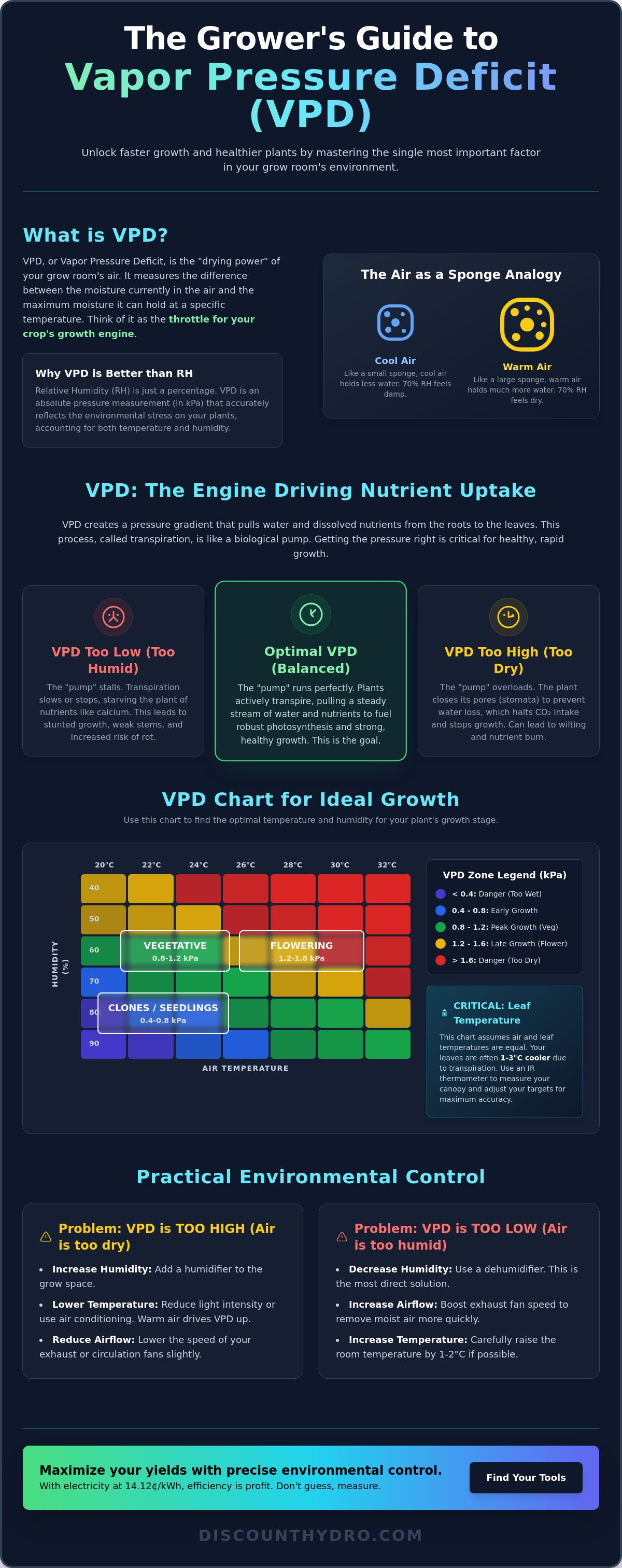
Identifying the correct zone on a vpd chart for grow rooms explained is vital for crop health. Most charts use a color-coded system to represent pressure levels in Kilopascals (kPa). Green zones indicate the sweet spot for maximum transpiration and growth. Purple zones warn of excessive humidity and dangerously low pressure. Yellow or orange zones signal high stress where plants lose water too quickly. Understanding these gradients allows you to adjust your humidifier or extractor fan before visible damage occurs. Don't treat the chart as a static target; it's a dynamic map that changes as your plants mature.
The Propagation Stage (0.4 – 0.8 kPa)
Cuttings and seedlings have limited root systems. They can't drink enough water to keep up with high transpiration rates. You must maintain a low VPD between 0.4 and 0.8 kPa to ensure survival. High humidity is mandatory during this phase to prevent the young plants from wilting. Using grow tents helps trap this moisture and maintain a consistent microclimate. This low-pressure environment prevents seedlings from drying out while they focus on root development. Be careful not to drop below 0.4 kPa for long periods. Extremely low pressure invites "damping off" and other fungal issues that thrive in stagnant, saturated air.
Vegetative and Flowering Stages (0.8 – 1.6 kPa)
Once roots are established, you can safely increase the atmospheric pressure. The vegetative "Sweet Spot" typically falls between 0.8 and 1.2 kPa. This range drives rapid foliage growth and keeps the nutrient pump moving efficiently through the stems. As you transition into the flowering stage, aim for 1.2 to 1.6 kPa. Higher VPD in late flower is a strategic choice. It helps prevent mould and bud rot by ensuring the air can absorb the moisture released by large, dense flowers. If the air is too full of moisture during this stage, rot can develop inside the flowers where airflow is restricted.
Never push your environment into the "Danger Zone" above 2.0 kPa. At this level, stomata close and plants suffer permanent tissue damage. Avoid the common mistake of "chasing the chart" without checking your hardware. A sensor might show a perfect 1.1 kPa, but if your air circulation is poor, the center of the canopy could be in a purple rot-prone zone. Stagnant air creates a boundary layer of moisture around the leaves that the chart cannot account for. Use the chart as a guide, but ensure your ventilation is capable of moving air through the entire plant structure. High-performance fans and extraction systems are just as important as the numbers on the screen.
Practical Environmental Control: How to Fix Your VPD
You don't need a high-end AI controller to manage your environment. Manual adjustments work perfectly if you follow a structured process. Mastering these five steps ensures your plants stay in the high-performance green zone of the chart. It's about using the tools you already have to create a more efficient "pump" for your nutrients.
- Step 1: Measure your base air temperature and relative humidity using a calibrated digital hygrometer.
- Step 2: Check leaf temperature with an IR thermometer. Subtract this from the air temperature to find your leaf temperature offset.
- Step 3: Consult a vpd chart for grow rooms explained to identify your current position. Determine if you need to move toward a higher or lower kPa.
- Step 4: Adjust your hardware. Use extraction fans, humidifiers, or heaters to shift the balance.
- Step 5: Monitor daily. External weather changes, such as a sudden rainstorm or heatwave, will shift your indoor baseline.
Fixing Low VPD (Too Humid/Cold)
When your room is too humid, the air is saturated and transpiration stops. This leads to stagnant growth and nutrient lockout. Start by increasing your extraction fan speed to pull in drier, fresher air from outside the tent. If the room is also cold, adding a small heater will lower the relative humidity (RH%) by increasing the air's water-holding capacity. Stagnant, humid air also creates the perfect environment for pests. You must learn to identify and prevent spider mites which thrive in these conditions. A dehumidifier is the most reliable tool for maintaining late-flower safety when large flowers release massive amounts of moisture.
Fixing High VPD (Too Dry/Hot)
Dry, hot air forces plants to transpire too fast, leading to salt build-up and wilting. To fix this, add a humidifier or reduce your extraction fan speed to trap more moisture inside the tent. If leaf temperatures are too high, lower your light intensity or increase the distance between your LED grow lights and the canopy. For growers on a budget, the "wet towel" trick works well in small spaces. Simply hang a damp towel near an intake fan to provide an emergency humidity boost. Always verify these changes with your vpd chart for grow rooms explained to avoid over-correcting and causing a spike in humidity.
Ready to take control of your environment? Buy extraction fans and humidifiers today to maintain the perfect VPD and maximize your yields.
Maximising ROI with High-Efficiency Lighting and VPD
Mastering your environment is a financial decision. With average commercial electricity rates at 14.12¢ per kilowatt-hour as of May 2026, running inefficient extraction fans or heaters is a waste of capital. Precision climate control ensures every watt of power and every drop of plant nutrients translates into yield. When you follow a vpd chart for grow rooms explained, you stop over-feeding and under-cooling. You create a streamlined production cycle that reduces waste and increases the final weight of your harvest. High light intensity requires a perfectly tuned environment to prevent photo-oxidation and nutrient lockout.
The correlation between Photosynthetic Photon Flux Density (PPFD) and VPD is absolute. As you increase light intensity, the plant's metabolic rate accelerates. This higher speed requires a more aggressive "pump" to move water and minerals. If your VPD is too low while your lights are at 100%, the plant cannot transpire fast enough to cool itself or move nutrients. This leads to internal heat stress and stunted growth. Properly balancing these variables allows you to push your crop to its genetic limit without the risk of burning the foliage.
The LED Advantage
Modern led grow lights, such as the Omega Black series, have changed the standard for environmental targets. Traditional HPS bulbs emit significant infrared heat that warms the leaf surface directly. LEDs are far more efficient and lack this radiant heat. This means leaf temperatures under LEDs are often lower than the surrounding air. You must run your grow room 2-3°C warmer than an HPS room to achieve the same metabolic rate. Adjusting your vpd chart for grow rooms explained for this leaf-to-air ratio is essential for maximum photosynthesis. Without this temperature boost, your plants will grow slowly despite having high-quality light.
Essential Tools for VPD Mastery
Precision requires the right hardware. You cannot manage what you do not measure. A reliable digital hygrometer provides your baseline, but an IR thermometer is the most important tool for finding your leaf temperature offset. Integrating these sensors with an automated fan controller allows for real-time adjustments. These controllers can increase or decrease fan speeds based on your target kPa, ensuring your room stays in the green zone even when you aren't there. Use this final checklist for a balanced 2026 grow room:
- High-efficacy LED lighting with adjustable dimming.
- Digital climate sensors with WiFi or smartphone integration.
- Infrared (IR) thermometer for daily leaf temperature checks.
- Variable speed extraction fans for pressure management.
- Premium mineral nutrients to support high transpiration rates.
Investing in quality gear reduces long-term operational costs. Precision control means your dehumidifiers and fans only run when necessary, saving on your monthly power bill while protecting your crop from rot and stress.
Optimize Your Environment for Maximum Yields
Mastering your atmosphere is the most effective way to increase final harvest weight and reduce operational waste. You've now got the knowledge to use a vpd chart for grow rooms explained to drive nutrient uptake and prevent issues like bud rot or wilting. By balancing temperature and humidity based on specific growth stages, you ensure the internal metabolic pump never stalls. Don't forget to account for the lack of infrared heat when using modern LED lighting; maintain slightly warmer room temperatures to hit your target kPa.
Ready to upgrade? Shop Precision Grow Room Climate Control at Discount Hydro for the tools you need to maintain a perfect environment. We provide competitive prices on top brands like Omega and Intense Nutrients. Our team offers expert technical support and fast UK-wide delivery to get your room running efficiently. Take the guesswork out of your climate settings and start seeing the results of a professional, balanced grow room today. Mastering these variables puts you in total control of your crop's success.
Frequently Asked Questions
Is a high or low VPD better for my plants?
Neither is universally better; the ideal level depends entirely on your plant's growth stage. Low VPD between 0.4 and 0.8 kPa is necessary for propagation and early growth to prevent young plants from drying out. Higher VPD between 1.2 and 1.6 kPa is required during late flowering to drive nutrient transport and prevent rot. You must match these levels to your current cycle to avoid metabolic stress.
How does leaf temperature affect the VPD chart?
Leaf temperature determines the actual vapor pressure inside the plant tissue. Most charts assume the canopy is 1-3°C cooler than the surrounding air because of evaporative cooling. If you ignore this offset, your calculations will be inaccurate. Using an IR thermometer ensures your vpd chart for grow rooms explained data remains precise, allowing you to make correct hardware adjustments for your specific environment.
What is the ideal VPD for the flowering stage?
The ideal range for the flowering stage is typically 1.2 to 1.6 kPa. This higher pressure encourages the plant to pull more water and minerals to support dense flower development. It also keeps the air dry enough to prevent fungal issues like grey mould or bud rot. Maintaining this specific window is critical for both yield quality and crop safety during the final weeks of the cycle.
Can I grow successfully without a VPD chart?
You can grow plants without one, but you lose the ability to maximize your crop's genetic potential. Growing without a chart means you're guessing at the relationship between temperature and humidity. You might keep plants alive, but you'll likely face slower growth or common nutrient deficiencies. Using a vpd chart for grow rooms explained provides a scientific roadmap for consistent, high-performance results every single harvest.
Why is my VPD different at night when the lights are off?
VPD changes at night because air temperature drops and relative humidity usually rises. When lights go out, plants stop photosynthesizing and close their stomata. Transpiration slows down significantly. If your VPD drops too low during this period, moisture can condense on the leaves and flowers. This creates a high risk for pathogens and rot to develop in the dark while airflow is often reduced.
Do I need a special sensor to measure VPD?
You don't need a specific VPD sensor, but you do need accurate tools for temperature and humidity. A high-quality digital hygrometer and an infrared thermometer are the standard requirements for manual calculations. Some modern environmental controllers calculate VPD automatically by combining these data points in real time. This automation helps you maintain a stable environment without performing manual checks throughout the day and night.
How does CO2 supplementation change my VPD requirements?
CO2 supplementation allows plants to handle higher temperatures and increased light intensity. Because the room is warmer, you often need a higher VPD to keep the transpiration pump active. Most CO2-enriched rooms target a slightly higher kPa to match the increased metabolic rate of the crop. This ensures the plant can process the extra carbon effectively without suffering from heat stress or stagnant nutrient flow.
What is the most common mistake when using a VPD chart?
The most common mistake is ignoring the leaf temperature offset. Many growers look at a chart and assume their leaf temperature matches the air temperature exactly. This leads to incorrect kPa targets and potential plant stress. Another frequent error is chasing the numbers while ignoring airflow. Even if the sensors show a perfect kPa, stagnant air around the leaves creates a humid microclimate that blocks effective transpiration.